2025-11-24 ラトガース大学
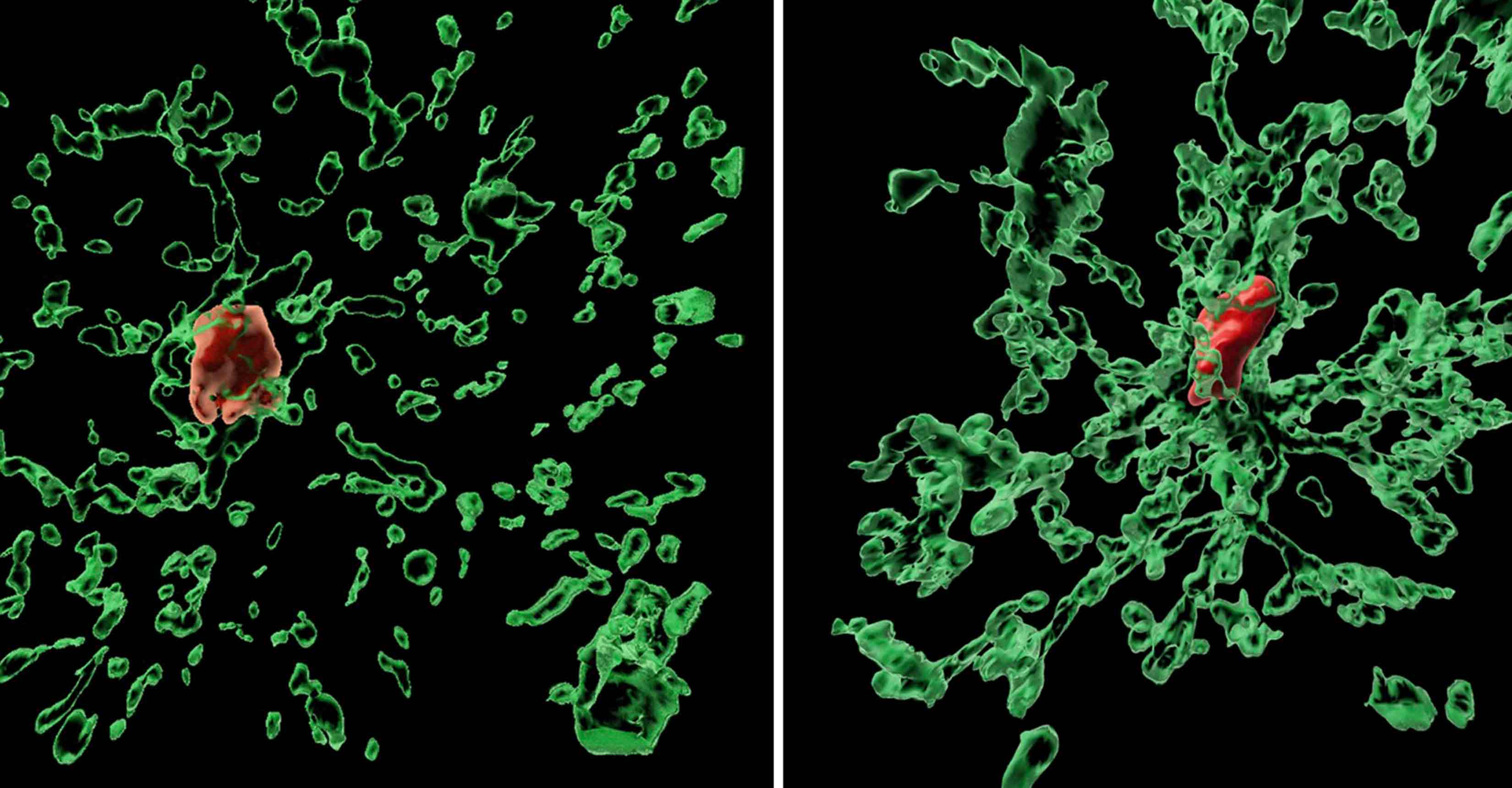
Scientists are finding that brain immune cells known as microglia with a specific mutation (at right) stayed young and avoided long-term inflammation that usually damages brain cells, conferring resilience against Alzheimer’s. They are contrasted with unmutated cells (at left.)Jiang Lab
<関連情報>
- https://www.rutgers.edu/news/inspired-familys-struggle-scientist-helps-uncover-defense-against-alzheimers-disease
- https://www.nature.com/articles/s41593-025-02117-8
骨髄トリソミー21関連遺伝子変異はアルツハイマー病を予防する A myeloid trisomy 21-associated gene variant is protective from Alzheimer’s disease
Mengmeng Jin,Ziyuan Ma,Rui Dang,Haiwei Zhang,Rachael Kim,Haipeng Xue,Jesse Pascual,Hanwen Yu,Ava V. Papetti,Yan Liu,Steven Finkbeiner,Elizabeth Head,Ying Liu & Peng Jiang
Nature Neuroscience Published:24 November 2025
DOI:https://doi.org/10.1038/s41593-025-02117-8
Abstract
Alzheimer’s disease causes progressive cognitive decline, yet some individuals remain resilient despite developing hallmark pathology. A subset of people with Down syndrome (DS), the most common genetic cause of Alzheimer’s disease, demonstrates such resilience. Given the elevated risk of hematopoietic mutations in DS, we hypothesize that certain variants may confer microglial resilience. Here, we introduce a myeloid DS-linked CSF2RB A455D mutation into human pluripotent stem cell-derived microglia from both donors with DS and healthy donors and study their function in 4–10-month-old chimeric mice. We find that this mutation suppresses type I interferon signaling in response to tau pathology, reducing inflammation while enhancing phagocytosis, thereby ameliorating microglial senescence. CSF2RB A455D-expressing microglia form a unique protective subpopulation and preserve neuronal functions. Importantly, they replace diseased wild-type microglia after tau exposure. These findings provide proof of concept that engineered human microglia can enhance resilience against tauopathy, opening avenues for microglial replacement therapies.