2025-12-04 東京農工大学
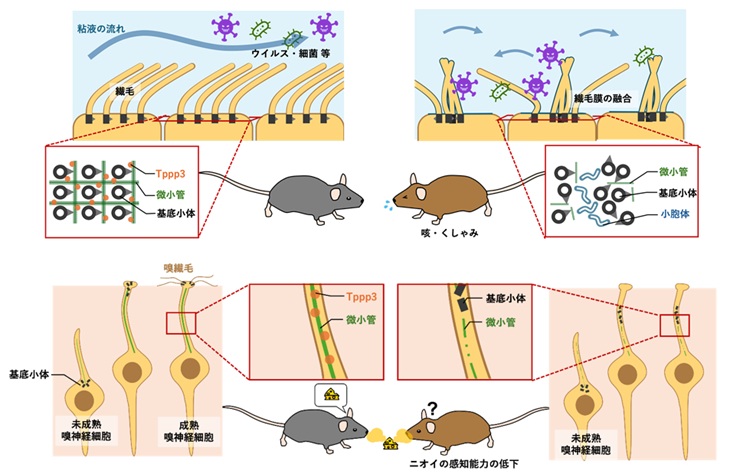
図1:気管と嗅上皮組織におけるTppp3蛋白質の役割。Tppp3は気管運動繊毛細胞(上)と嗅神経細胞(下)それぞれの細胞内部の微小管構造形成を担う事で繊毛の方向性・膜の独立性・中心体の配置を制御する。Tppp3遺伝子を欠損した遺伝子改変マウスでは咳・くしゃみ、および嗅覚障害の表現型を示す
<関連情報>
- https://www.tuat.ac.jp/outline/disclosure/pressrelease/2025/20251204_01.html
- https://www.tuat.ac.jp/documents/tuat/outline/disclosure/pressrelease/2025/20251204_01.pdf
- https://www.pnas.org/doi/10.1073/pnas.2503931122
Tppp3は微小管の組み立てとスフィンゴ脂質の恒常性を介して呼吸繊毛の基底小体の位置とアイデンティティを決定する Tppp3 determines basal body positioning and identity of respiratory cilia via microtubule assembly and sphingolipid homeostasis
Takafumi Sakai https://orcid.org/0009-0009-9533-6909, Masahiro Kawakita, Arashi Seki, +25 , and Kyosuke Shinohara
Proceedings of the National Academy of Sciences Published:December 1, 2025
DOI:https://doi.org/10.1073/pnas.2503931122
Significance
In mammals, multiciliated cells (MCCs) harbor hundreds of motile cilia. In the tracheal MCCs, all the individual cilium beat along the oral–lung axis and generate unidirectional mucus flow. However, there are long-standing issues about the mechanisms of how an individual cilium knows the proper orientation and how the identity of individual cilium membranes are maintained. Our study demonstrates that Tppp3 assembles the apical microtubule (MT) meshwork that determines the unidirectional orientation and the subcellular cilium positioning in the mouse trachea. Furthermore, Tppp3 governs independency of individual ciliary membranes via sphingolipid homeostasis. Surprisingly, Tppp3 regulates not only motile cilia function but olfactory sensory cilia function. Our data unveil the long-awaited biological mechanism underlying respiratory diseases and hyposmia.
Abstract
Cilia are hair-like organelles that protrude from the cell surface. In mammals, tracheal multiciliated cells (MCCs) play an important role in elimination of hazardous microorganisms by driving a unidirectional mucus flow. Although uniform orientation of ciliary beating is critical for the unidirectional flow, it remains unknown how MCCs establish uniform orientations and maintain identities of hundreds of ciliary membranes. This study focuses on investigating the roles of Tubulin Polymerization Promoting Family Member 3 (Tppp3) in MCC function. We generated a Tppp3-deficient mouse (Tppp3∆ex2-4/∆ex2-4; Tppp3 knockout (KO)) and found that the Tppp3 KO mouse exhibited cough and hyposmia phenotype. The loss of Tppp3 disrupted the apical microtubules (MTs) meshwork in the tracheal MCCs, leading to random orientation and alignment of basal bodies (BBs) of the motile cilia. Unexpectedly, aberrant ciliary membrane fusions occurred in the trachea of the Tppp3 KO mice. We examined the underlying molecular mechanism of the ciliary membrane fusion by isolating the tracheal cilium. Liquid Chromatography-Mass Spectrometry (LC–MS) analysis as well as pharmacological analysis revealed that hyperaccumulation of a long chain ceramide at the ciliary membrane caused the membrane fusion. In addition, sensory cilia formation was impaired in the olfactory sensory neuron of the Tppp3 KO mice. Due to the lack of Tppp3, dendritic MT assembly that underlies long-range migration of BBs toward the cell surface was impaired. These findings demonstrate that Tppp3, as well as the defined intracellular MT architecture, regulate proper orientation/subcellular positioning of BBs and the independency of individual motile cilium membranes.