2025-12-09 京都大学
<関連情報>
- https://www.kyoto-u.ac.jp/ja/research-news/2025-12-09-1
- https://www.kyoto-u.ac.jp/sites/default/files/2025-12/web_2512_Inoue-3258bc90ad975d922b733743ffc4ed14.pdf
- https://academic.oup.com/ije/article/54/6/dyaf201/8341155?login=false
退職と認知機能の関連性における異質性:19カ国を対象とした機械学習分析 Heterogeneity in the association between retirement and cognitive function: a machine learning analysis across 19 countries
Koryu Sato,Haruko Noguchi,Kosuke Inoue
International Journal of Epidemiology Published:24 November 2025
DOI:https://doi.org/10.1093/ije/dyaf201
Abstract
Background
Rising state pension ages in many developed countries may influence cognitive aging by delaying retirement, yet the cognitive consequences of retirement likely vary across individuals and contexts. This study investigates the heterogeneous association between retirement and cognitive function.
Methods
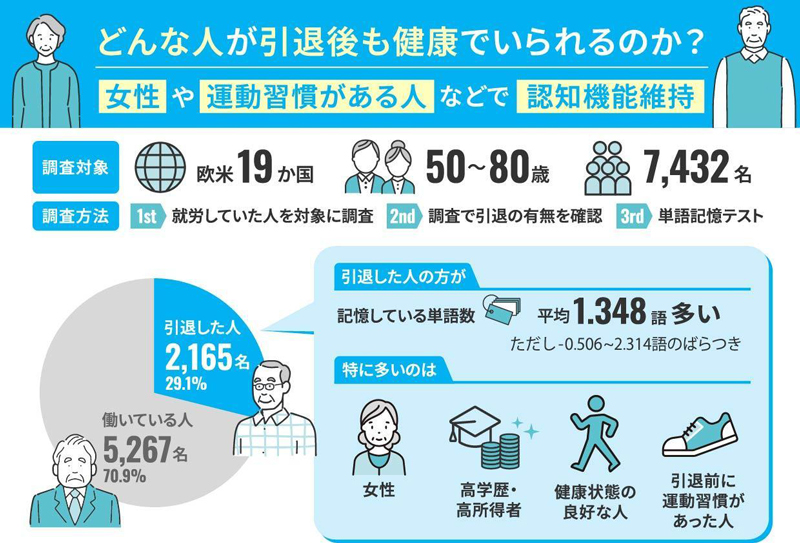
We analyzed harmonized data from three longitudinal studies: the Health and Retirement Study, the English Longitudinal Study on Ageing, and the Survey of Health, Ageing and Retirement in Europe. The dataset encompassed three waves across 19 counties from 2014 to 2019. Our study included 12 811 individuals who worked in the first wave, from whom each survey collected covariate information. We assessed retirement status among participants aged 50–80 years in the second wave and measured cognitive function using word recall tests in the third wave. The analysis employed instrumental variable causal forests estimation, utilizing state pension age as an instrument for retirement.
Results
Among 7432 individuals with retirement propensity scores between 0.1 and 0.9, 2165 (29.1%) retired during the second wave. Analysis revealed that retirees recalled 1.348 more words than workers on average. The association between retirement and cognitive function was heterogeneous; greater cognitive benefits were observed among women, individuals with higher socioeconomic status, those with robust pre-retirement health, and those who engaged in physical activity before retirement.
Conclusions
The observed heterogeneous associations suggest policymakers should consider incorporating early retirement options into the pension system, allowing individuals to make retirement decisions based on their circumstances.