2025-12-10 ケンブリッジ大学
<関連情報>
- https://www.cam.ac.uk/stories/monogamy-league-table
- https://royalsocietypublishing.org/rspb/article/292/2060/20252163/363965/Human-monogamy-in-mammalian-context
哺乳類における人間の一夫一婦制 Human monogamy in mammalian context
Mark Dyble
Proceedings of the Royal Society B: Biological Sciences Published:10 Dec 2025
DOI:https://doi.org/10.1098/rspb.2025.2163
Abstract
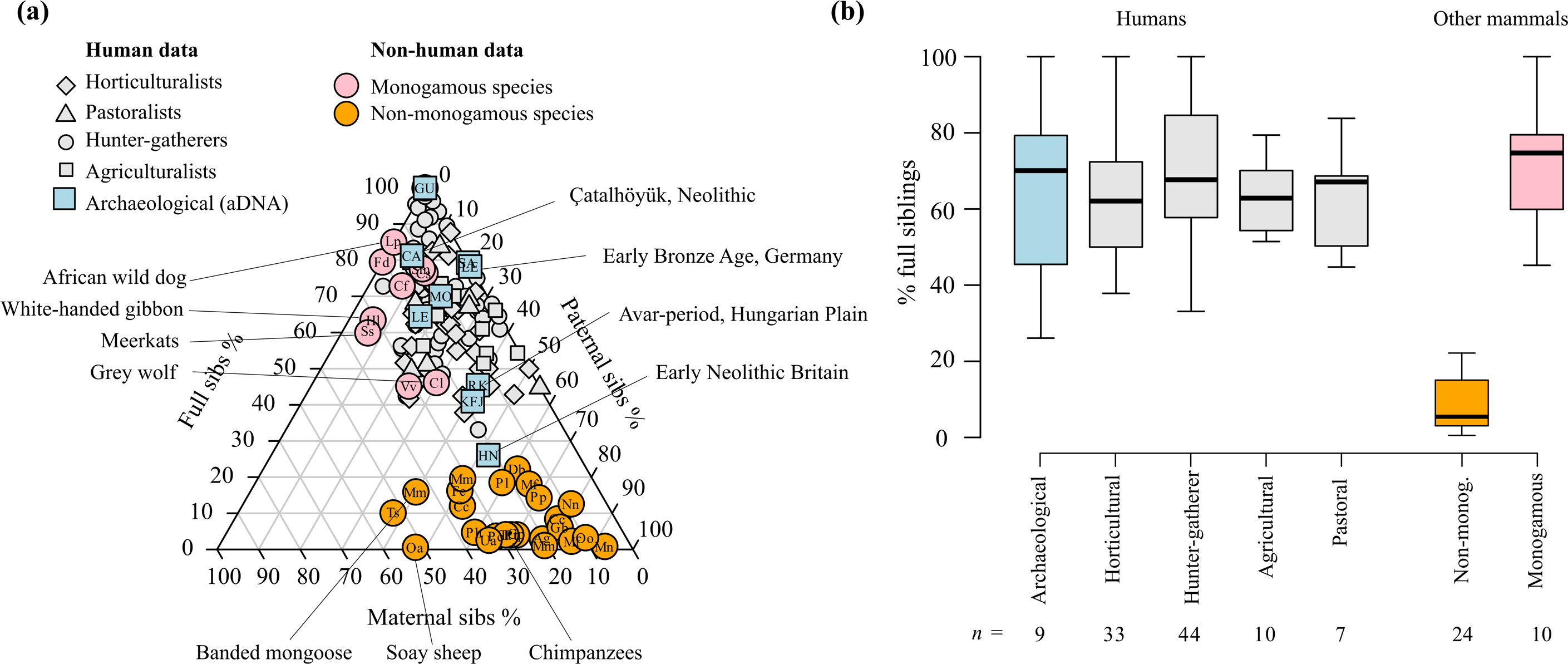
Monogamy has been argued to have played an important role in human evolution and, across animals more generally, evolutionary transitions to highly cooperative societies have been far more likely to occur in monogamous species, raising the possibility that this may have also been the case for humans. However, the extent to which we can consider monogamy to be the typical human mating system is subject to debate. Here, I provide comparative context on human mating behaviour by comparing the distribution of sibling types (full siblings versus half-siblings) across more than 100 human societies with equivalent data from 34 non-human mammal species. While cross-culturally variable, rates of full siblings in humans cluster closely with rates seen among socially monogamous mammals and fall consistently above the range seen in non-monogamous mammals. Although the human data is demonstrative of considerable cross-cultural diversity in marriage and mating practices, the overall high frequency of full siblings is consistent with the characterization of monogamy as the modal mating system for humans.