2025-12-11 名古屋大学
<関連情報>
- https://www.nagoya-u.ac.jp/researchinfo/result/2025/12/post-917.html
- https://www.nagoya-u.ac.jp/researchinfo/result/upload_images/20251211_med.pdf
- https://aacrjournals.org/cancerres/article/doi/10.1158/0008-5472.CAN-25-3425/770662/Microglia-Display-Heterogeneous-Initial-Responses
ミクログリアは播種性腫瘍細胞に対して多様な初期反応を示す Microglia Display Heterogeneous Initial Responses to Disseminated Tumor Cells
Takahiro Tsuji;Haruka Hirose;Daisuke Sugiyama;Mariko Shindo;Rahadian Yudo. Hartantyo;Yutaro Saito;Tsuyako Tatematsu;Shouta Sugio;Makoto Sanbo;Masumi Hirabayashi;Yasuhiro Kojima;Jun Koseki;Kazutaka Hosoya;Hiroshi Yoshida;Tatsuya Ogimoto;Yuto Yasuda;Kentaro Hashimoto;Hitomi Ajimizu;Yuichi Sakamori;Hironori Yoshida;Noritaka Sano;Masahiro Tanji;Hiroaki Ito;Kazuhiro Terada;Masatsugu Hamaji;Toshi Menju;Hiroyuki Konishi;Shogo Kumagai;Cyrus M. Ghajar;Daisuke Kato;Hiroshi Date;Akihiko Yoshizawa;Yoshiki Arakawa;Hiroaki Ozasa;Andrew J. Moorhouse;Teppei Shimamura;Hiroyoshi Nishikawa;Toyohiro Hirai;Hiroaki Wake
Cancer Research Published:December 10 2025
DOI:https://doi.org/10.1158/0008-5472.CAN-25-3425
Abstract
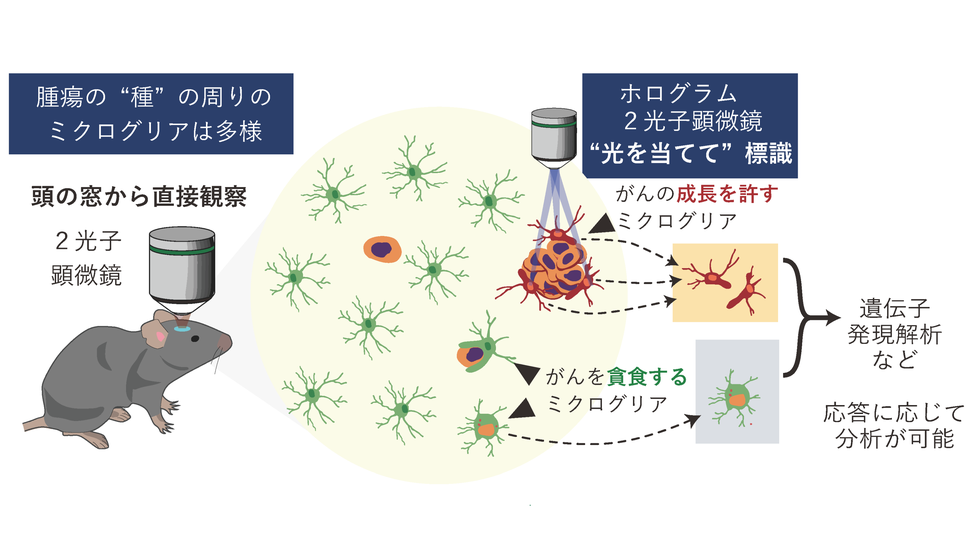
Brain metastases are frequent and often lethal complications of advanced cancers. Microglia, resident immune cells of the brain, are known to exert both anti-tumor and pro-tumor functions in late-stage metastases; however, their response during the initial outgrowth of metastatic lesions is not well characterized. Understanding how heterogeneous microglial subgroups are regulated in the developing tumor microenvironment could pave the way for therapeutic strategies to eliminate metastatic tumors at an early stage. In this study, we used a combination of in vivo fate map imaging, single-cell RNA sequencing, and a holographic photoconversion-based technique (Opto-omics) to track tumor fate and early microglial responses over time in the same animals during colonization of disseminated tumor cells. The microglial population was transcriptionally and morphologically heterogeneous, comprising both pro- and anti-tumor subsets. Genetic and pharmacological perturbations revealed that microglial phenotypes could be shifted by inhibiting TGF-β signaling or by deleting the tumor cell surface antigens CD24a and CD47. These findings reveal targetable plasticity in early-stage microglial responses to brain metastasis and suggest that harnessing pro-phagocytic microglial states may offer a therapeutic window before systemic immunosuppression becomes dominant.