2025-12-17 国立遺伝学研究所
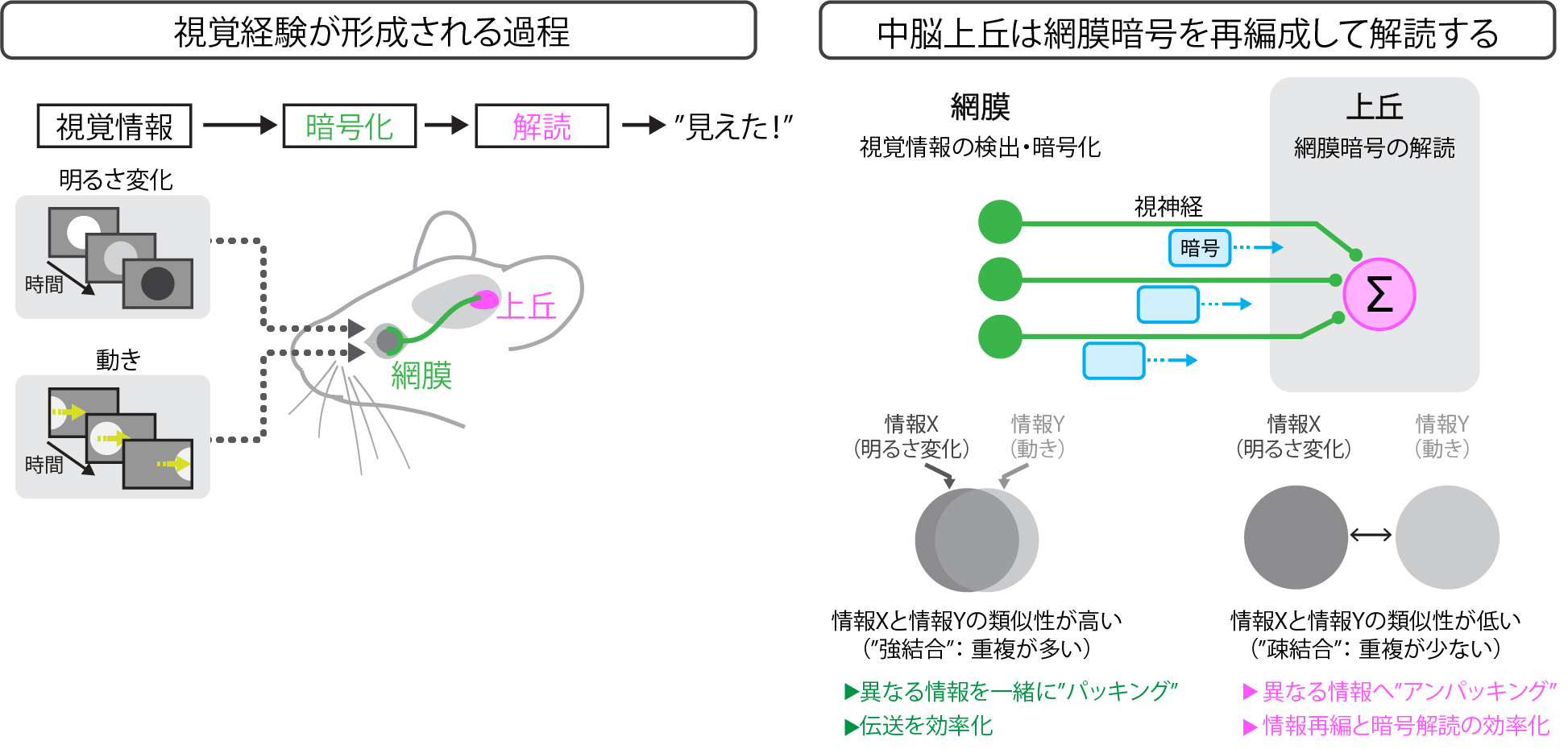
(左)視覚経験が形成される視覚情報処理経路。視覚情報は網膜において検出、暗号化され、上丘へ伝送される。(右)網膜では、「明るさ変化(情報X)」と「動き(情報Y)」の2種類の視覚情報を表現する神経活動の相互情報量が高い。上丘では、網膜暗号の重複性が解消される。
<関連情報>
- https://www.nig.ac.jp/nig/ja/2025/12/research-highlights_ja/pr20251217.html
- https://www.nig.ac.jp/nig/images/research_highlights/PR20251217.pdf
- https://www.cell.com/current-biology/abstract/S0960-9822(25)01554-4
網膜丘路における視覚特徴選択性の分離 Decoupling of visual feature selectivity in the retinocollicular pathway
Ole S. Schwartz ∙ Akihiro Matsumoto ∙ Haruka Yamamoto ∙ Keisuke Yonehara
Current Biology Published:December 16, 2025
DOI:https://doi.org/10.1016/j.cub.2025.11.050
Highlights
- Information analysis evaluated “couplings” between visual response features
- The retina, a visual sensory organ, shows coupled luminance and motion responses
- The retinorecipient superior colliculus shows decoupled luminance and motion responses
- Feature selectivity decoupling reduces cluster separability in collicular neurons
Summary
The retina is composed of discrete functional cell types that are also characterized by distinct morphology and gene expression. It remains, however, unclear whether similar discrete functional cell types exist in the visual regions downstream of the retina. Here, we used two-photon calcium imaging to investigate the response-space structure in the retina and in the superficial layers of the mouse superior colliculus (SC), a major retinorecipient area. We found that although retinal ganglion cells showed a clear dependence between responses to luminance and motion, responses to the two stimuli exhibited weaker couplings in collicular neurons. Because of this decoupling, functional clustering based on responses to both luminance and motion had significantly reduced separability compared with clustering based on responses to either. Our work suggests that the SC is not simply a relay station for retinal inputs but rather generates novel feature selectivity that diversifies cellular responses, perhaps through nonlinear neural processes involving the decoupling and recoupling of retinal ganglion cells’ feature selectivity.