2026-01-07 東京大学
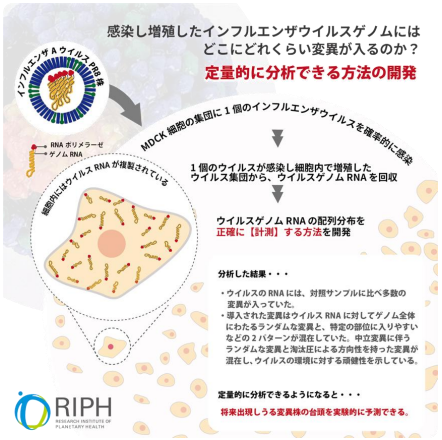
図 1:本研究の概略図
<関連情報>
- https://www.u-tokyo.ac.jp/focus/ja/press/z1701_00082.html
- https://www.u-tokyo.ac.jp/content/400277235.pdf
- https://elifesciences.org/articles/108882
インフルエンザウイルスの準種における遺伝子配列の異質性が単一分子シーケンシングによって明らかに Heterogeneity of Genetic Sequence within Quasi-species of Influenza Virus Revealed by Single-Molecule Sequencing
Kenji Tamao,Hiroyuki Noji,Kazuhito V Tabata
eLife Published:Jan 6, 2026
DOI:https://doi.org/10.7554/eLife.108882.3
Abstract
Influenza viruses exhibit high mutation rates and extensive genetic diversity, which hinder effective vaccine development and facilitate immune evasion (Taubenberger and Morens, 2006; Barr et al., 2010). These mutations arise from the error-prone viral RNA-dependent RNA polymerase, generating highly heterogeneous viral populations within individual hosts that conform to the quasi-species model of a cloud of related genomes evolving under selection (Domingo et al., 2012). Accurate characterization of this intra-host diversity is crucial for understanding viral evolution and improving vaccine design, yet conventional RNA sequencing often fails to detect low-frequency variants because of technical errors during sample preparation and sequencing. Here, we implement a single unique molecular identifier strategy that reduces sequencing artifacts and achieves an error rate of ~10⁻⁵, enabling single-particle–level quantification of quasi-species diversity. Mutation frequencies greatly exceeding background error confirm their biological origin, while information-theoretic metrics such as Shannon entropy and Jensen–Shannon divergence reveal non-random mutation distributions under selective constraints. This framework supports detailed studies of intra-host viral evolution and may inform artificial intelligence-driven prediction of mutational trajectories and more effective influenza vaccine strategies.