2026-01-07 中山大学(SYSU)
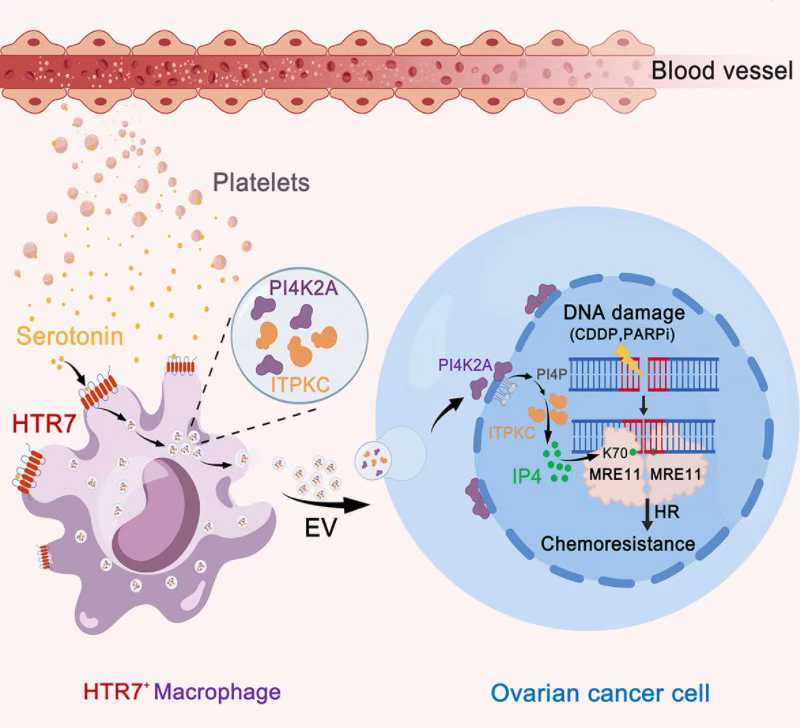
Working Mechanism Diagram
<関連情報>
- https://www.sysu.edu.cn/sysuen/info/1012/58291.htm
- https://www.sciencedirect.com/science/article/abs/pii/S1550413125004954
セロトニン誘導マクロファージはイノシトール代謝を介して卵巣癌の化学療法抵抗性を増強する Serotonin-licensed macrophages potentiate chemoresistance via inositol metabolic crosstalk in ovarian cancer
Jie Li, Jingyi Lu, Cuimiao Zheng, Xi Huang, Haoyuan Li, Qiuwen Mai, Siqi Chen, Zhou Zhou, Jiayu Zhu, Tiantian Yu, Manman Xu, Hao Tan, Chun-min Zhang, Qinglei Gao, Junxiu Liu, Chaoyun Pan
Cell Metabolism Available online: 17 December 2025
DOI:https://doi.org/10.1016/j.cmet.2025.11.011
Highlights
- A serotonin-responding HTR7+ TAM enhances HR repair in ovarian tumors
- The serotonin-activated TAMs secrete EVs to elevate nuclear IP4 in cancer cells
- IP4 binds MRE11 to promote its DNA-binding activity and facilitate HR repair
- Fluoxetine disrupts serotonin-enhanced HR repair and potentiates chemotherapy
Summary
Therapeutic resistance in solid tumors frequently stems from enhanced homologous recombination (HR) repair capacity, yet systemic regulators of this pathway remain poorly defined. Here, we identify a serotonin-sensitive tumor-associated macrophage (TAM) subpopulation that orchestrates inositol metabolic crosstalk to potentiate HR repair in cancer cells. This TAM subset exhibited marked enrichment in ovarian tumors with low response to chemotherapy. Mechanistically, peripheral serotonin activates these TAMs via serotonin receptor HTR7, triggering extracellular vesicle (EV) secretion enriched with inositol metabolic enzymes PI4K2A and ITPKC. EV-mediated transfer of these metabolic enzymes elevates nuclear inositol-1,3,4,5-tetraphosphate (IP4) in cancer cells, where IP4 directly binds MRE11 and facilitates MRE11-DNA binding and HR repair. Attenuating peripheral serotonin using fluoxetine—a selective serotonin reuptake inhibitor (SSRI) antidepressant—ablates TAM-derived EV delivering of inositol metabolic enzymes and sensitizes tumors to cisplatin/PARP inhibitor (PARPi). Our study unveils a systemic serotonin-primed metabolic crosstalk within the tumor microenvironment that potentiates chemoresistance, revealing targetable HR repair regulation beyond cancer-cell-autonomous mechanisms.