2026-01-08 京都大学
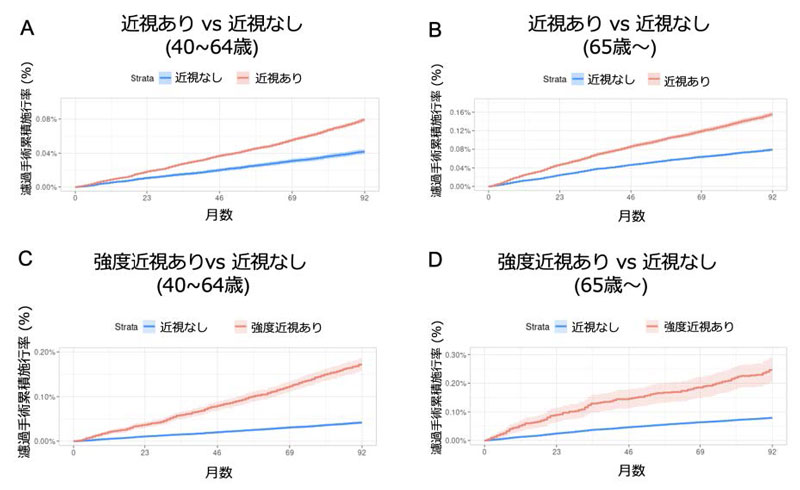
追跡期間を通じて、濾過手術に至る割合は非近視群よりも近視群で高く、特に強度近視群でより高い傾向が認められた。40~64歳(パネルA:近視あり vs 近視なし、パネルC:強度近視あり vs 近視なし)と65歳以上(パネルB、D)に分けて示してある。
<関連情報>
- https://www.kyoto-u.ac.jp/ja/research-news/2026-01-08-0
- https://www.kyoto-u.ac.jp/sites/default/files/2026-01/web_2601_Miyake-84ddf6f99ce466f77a48f0ad30dbfbaa.pdf
- https://www.aaojournal.org/article/S0161-6420(25)00811-5/fulltext
近視・強度近視眼における緑内障発症および緑内障手術リスク:全国コホート研究 Risk of Glaucoma and Undergoing Glaucoma Surgery in Myopic and Highly Myopic Eyes: A Nationwide Population-Based Cohort Study
Masahiro Akada, M.D. ∙ Masayuki Hata, M.D., Ph.D. ∙ Takuro Kamei, M.D. ∙ … ∙ Hiroshi Tamura, M.D., Ph.D., ScM, ∙ Akitaka Tsujikawa, M.D., Ph.D. ∙ Masahiro Miyake, M.D., Ph.D., M.P.H.
Ophthalmology Published:January 5, 2026
DOI:https://doi.org/10.1016/j.ophtha.2025.12.025
Abstract
Purpose
To evaluate the risk of glaucoma development and the necessity for glaucoma surgery among patients with myopia and high myopia.
Design
A longitudinal, nationwide, population-based cohort study.
Participants
A total of 14,204,347 phakic individuals aged ≥40 years, with claims indicating refraction testing between September 2014 and August 2015, were followed from September 2015 to March 2023.
Methods
Using validated algorithms, participants were classified into three groups based on refractive error status—non-myopia, myopia, and high myopia (spherical equivalent ≤ –6.0 D). The high myopia group was considered a subset of the myopia group. The risk of developing glaucoma and the requirement for glaucoma surgery over 7.5 years were assessed through Cox proportional hazards regression, adjusting for potential confounders.
Main Outcome Measures
The primary outcomes were the development of glaucoma and the requirement for glaucoma surgery.
Results
Among the 14,204,347 participants, 7,478,999 were identified as having any degree of myopia, including 373,232 patients who met the criteria for high myopia. The mean age was 68.8 years in the non-myopia group and 56.8 years in the myopia group, with women comprising over 60% of each group. Comorbidities including diabetes, hypertension, and dyslipidemia were more prevalent in individuals without myopia. After adjusting for age, sex, diabetes, hypertension, and dyslipidemia, the adjusted hazard ratio (aHR) for developing glaucoma was 1.44 (95% confidence interval [CI]: 1.43–1.45) for the myopia group and 2.67 (95% CI: 2.62–2.73) for the high myopia group. Regarding glaucoma surgery, the aHR was 1.71 (95% CI: 1.67–1.75) for the myopia group and 3.07 (95% CI: 2.91–3.25) for the high myopia group. Notably, the aHR for filtering surgery such as trabeculectomy was 2.03 (95% CI: 1.94–2.11) for the myopia group and 4.03 (95% CI: 3.67–4.42) for the high myopia group.
Conclusions
Both myopia and high myopia significantly increase the risk of developing glaucoma and the likelihood of requiring glaucoma surgery, especially for invasive filtering surgeries. These findings suggest a need for diligent glaucoma screening and proactive management for individuals with myopia.