2026-01-09 ワシントン大学セントルイス校
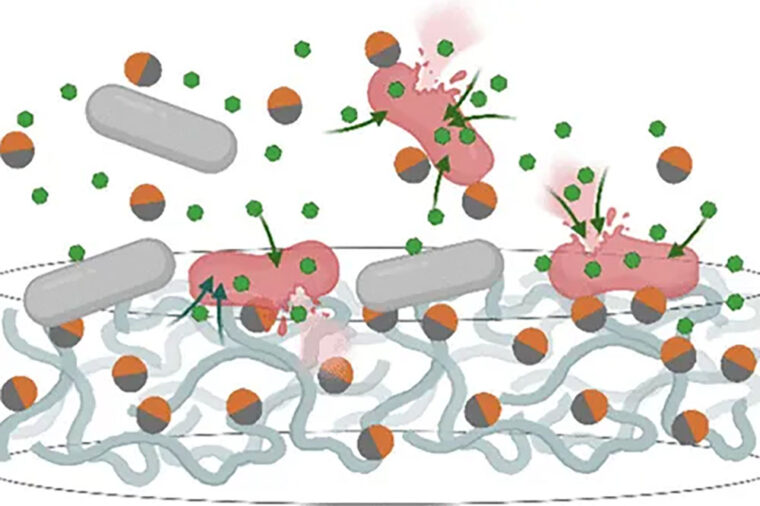
An illustration of two-sided nanoparticles adhering to bacteria. (Image: American Chemical Society)
<関連情報>
- https://source.washu.edu/2026/01/reviving-antibiotics-with-two-faced-nanoparticles/
- https://artsci.washu.edu/ampersand/reviving-antibiotics-two-faced-nanoparticles
- https://pubs.acs.org/doi/full/10.1021/acs.nanolett.5c05337
両親媒性ヤヌスナノ粒子は抗生物質と相乗効果を発揮し、薬剤耐性グラム陰性細菌の感受性を回復させる Amphiphilic Janus Nanoparticles Synergize with Antibiotics to Restore Susceptibility in Drug-Resistant Gram-Negative Bacteria
Martijn Zwama,Swagata Bhattacharyya,Nozomi Sakurai,Kunihiko Nishino,and Yan Yu
Nano Letters Published: November 26, 2025
DOI:https://doi.org/10.1021/acs.nanolett.5c05337
Abstract
Antibiotic resistance in bacteria poses a global health challenge, underscoring the need for strategies that restore the effectiveness of existing drugs. Here, we demonstrate that amphiphilic Janus nanoparticles (NPs), with separate polycationic and hydrophobic hemispheres, act as effective antibiotic adjuvants that synergistically enhance the activity of conventional antibiotics. Unlike uniformly cationic NPs, Janus NPs exhibited strong synergy with multiple antibiotics against Acinetobacter baumannii, including the multidrug-resistant clinical isolate A. baumannii A42-2. Embedding Janus NPs in agar gel provided a stable platform that reproducibly increased antibiotic susceptibility in various Gram-negative bacteria, including A. baumannii and highly motile species such as Escherichia coli. These findings demonstrate that amphiphilic Janus NPs can synergistically boost antibiotic activity and that embedding them in gels yields a stable platform for assessing their performance and potentially deploying them in future biomedical applications.