2026-01-13 京都大学
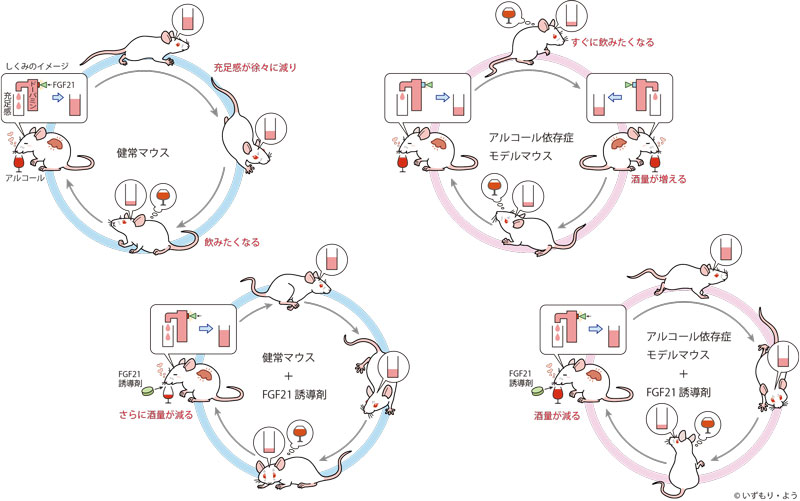
©️いずもり・よう
<関連情報>
- https://www.kyoto-u.ac.jp/ja/research-news/2026-01-13
https://www.kyoto-u.ac.jp/sites/default/files/2026-01/web_2601_Sasaki-7f3873df655167f63889cf45b7683636.pdf - https://www.pnas.org/doi/10.1073/pnas.2525172122
FGF21-PVH オキシトシン-VTA ドーパミン系は、飲酒量を負に調節する Negative feedback regulation of alcohol ingestion through the FGF21-PVH oxytocin-VTA dopamine system
Sho Matsui, Yuma Takahashi, Shuhei Morioka, +9 , and Tsutomu Sasaki
Proceedings of the National Academy of Sciences Published:January 14, 2026
DOI:https://doi.org/10.1073/pnas.2525172122
Significance
Excessive alcohol consumption represents a major global health issue, with limited effective countermeasures for prevention and treatment. Although alcohol ingestion is generally known to produce immediate pleasure, this study revealed that the VTA DA system is activated several hours after alcohol ingestion with a delay and functions as a homeostatic replenishment signal. This finding provides a broad perspective on potential strategies for preventing excessive drinking. Specifically, D-allulose, a compound known to induce FGF21, activates this system, suggesting a promising approach for preventing alcohol dependence. FGF21-inducing nutraceuticals could serve as a complementary treatment to existing therapeutic options, offering a broad avenue to address alcohol-related health challenges.
Abstract
Alcohol has a notable negative impact on global health. Understanding its physiological regulation is crucial to addressing alcohol use. Here, we show that FGF21-oxytocin neurons in the paraventricular nucleus of the hypothalamus (PVHOXT)-dopamine neurons in the ventral tegmental area (VTADA) negatively regulate the drive to drink alcohol. Alcohol induces FGF21 signaling, which activates PVHOXT and induces oxytocin release in the VTA. The VTADA neurons are activated hours after alcohol ingestion, which reduces the drive to drink alcohol, extends the interdrink interval, and thereby reduces alcohol consumption. The system is downregulated in a mouse model of alcohol dependence, and activating the system with FGF21-inducing sugars reduces alcohol ingestion and prevents binge drinking and alcohol dependence. Therefore, FGF21-inducing nutraceuticals can substitute for alcohol by supplementing the FGF21-PVHOXT-VTADA negative feedback signal to attenuate alcohol-related behaviors in mice.