2026-01-15 国立成育医療研究センター
<関連情報>
- https://www.ncchd.go.jp/press/2026/0115.html
- https://www.ncchd.go.jp/press/2026/0115.pdf
- https://onlinelibrary.wiley.com/doi/10.1111/xen.70105
異種移植に必要とされる社会的な準備とは? 日本の一般市民を対象とした調査研究 What Kind of Social Preparations Are Needed for Xenotransplantation? A Survey Study of the Japanese General Public
Ayako Kamisato, Satoshi Hosoya
Xenotransplantation Published: 28 December 2025
DOI:https://doi.org/10.1111/xen.70105
ABSTRACT
Introduction
With the advent of genome editing technology, xenotransplantation has been attracting attention in recent years as a potential solution to the shortage of organs for transplantation. In Japan, several Japanese universities have reportedly been preparing for the first Japanese clinical trial. However, xenotransplantation poses social issues. Therefore, it is necessary to understand the public’s awareness and opinions of it, and policymakers and researchers of xenotransplantation must prepare for social issues.
Materials and Methods
In December 2024, an online survey was conducted on Japanese aged 20 to 79, asking questions about their awareness, acceptability, and preferred transplant method. IBM SPSS was used for statistical analysis, and correlations with attributes were also examined.
Results
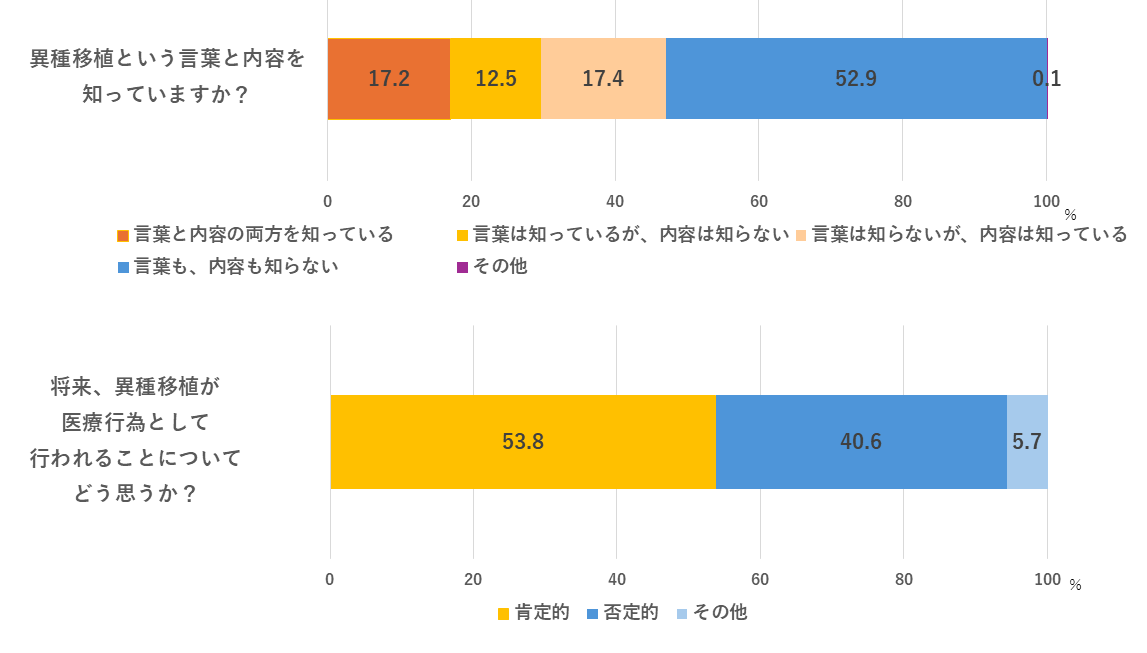
Valid responses were obtained from 3209 people (response rate: 10.8%). Only 34.6% knew the meaning of xenotransplantation, and 53.8% had a favorable opinion about xenotransplantation being performed as a medical treatment in the future. However, 77.0% predicted that they would feel uncomfortable if a doctor suggested xenotransplantation to them, and 60.9% predicted that they would decide not to undergo xenotransplantation. Fifty-eight percent responded that they would be anxious about discrimination, and 88.2% responded that they would be anxious about being infected with animal-derived pathogens if they received a xenotransplant. In addition, only 1.7% ranked xenotransplantation as their first preference.
Conclusion
The results imply the Japanese public is not ready enough to accept xenotransplantation. This study proposes four points that policymakers and researchers should prepare for social issues before the clinical trial begins in Japan.