2026-02-03 国立再生可能エネルギー研究所(NREL)
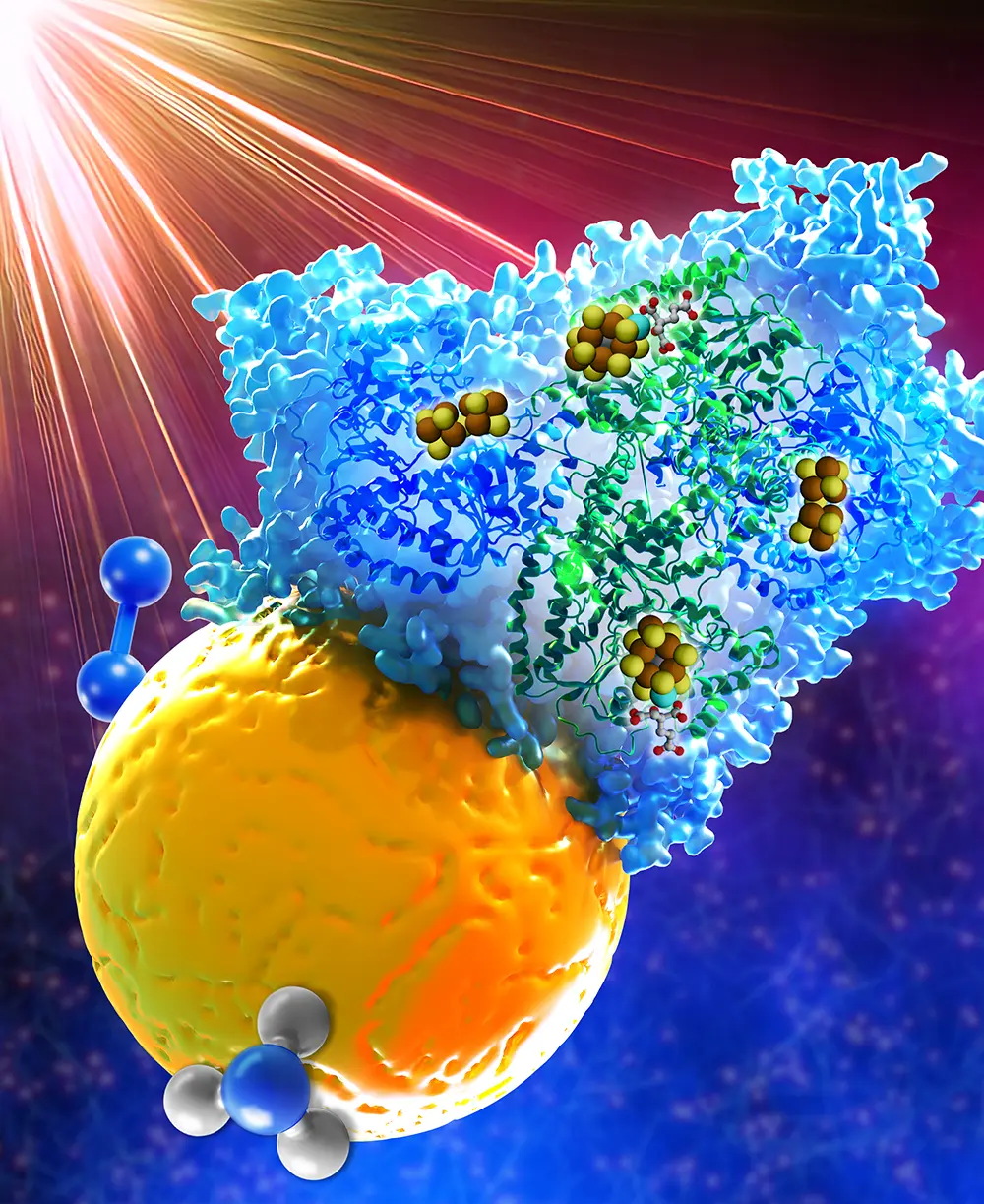
The illustration showcases a model complex between a cadmium sulfide quantum dot (yellow sphere) and a molybdenum-iron protein (blue ribbon) during electron transfer, which results in ammonia conversion (shown as blue-white spheres). Illustration by Besiki Kazaishvili, National Laboratory of the Rockies
<関連情報>
- https://www.nlr.gov/news/detail/program/2026/could-light-be-used-to-drive-enzymes-for-efficient-ammonia-production
- https://www.cell.com/cell-reports-physical-science/fulltext/S2666-3864(25)00331-5
ナノクリスタル:モリブデン窒素固定酵素バイオハイブリッドの前定常状態動力学は、正孔消去効率がN 2還元に重要であることを明らかにする Pre-steady-state kinetics of nanocrystal:molybdenum nitrogenase biohybrids reveals hole-scavenging efficiency is critical to N2 reduction
Peter J. Dahl ∙ Lauren M. Pellows ∙ Zhi-Yong Yang ∙ … ∙ Gordana Dukovic ∙ David W. Mulder ∙ Paul W. King
Cell Reports Physical Science Published:July 30, 2025
DOI:https://doi.org/10.1016/j.xcrp.2025.102732
Highlights
- Time-resolved detection of light-driven MoFe protein N2 reduction intermediates
- The first pre-steady-state kinetic model of light-driven ammonia production
- Describes the inter-relationship of light-driven oxidative and reductive reactions
- Identifies competing side reactions that inhibit N2 reduction by MoFe protein
Summary
Molybdenum (Mo) nitrogenase is a two-component enzyme complex that catalyzes the reduction of dinitrogen to ammonia and protons to hydrogen gas. We have shown that electrons for dinitrogen reduction can be delivered photochemically to the catalytic MoFe protein component by cadmium sulfide (CdS) nanocrystals. In this study, we used electron paramagnetic resonance spectroscopy to measure the transient populations of catalytic intermediates. We fit the populations with a pre-steady-state kinetic model, which allowed us to distinguish between productive and non-productive reaction pathways and extract the rate constants for the reaction. Our results demonstrated that the rate of catalytic electron delivery into MoFe protein increased with the concentration of the sacrificial electron donor. This enabled electron delivery to exceed the rate of hydride protonation, a relaxation pathway that competes with N2 binding. Thus, managing the balance between electron transfer and hole transfer reactions is required to achieve a kinetic regime that favors N2 reduction.