2026-02-04 東北大学
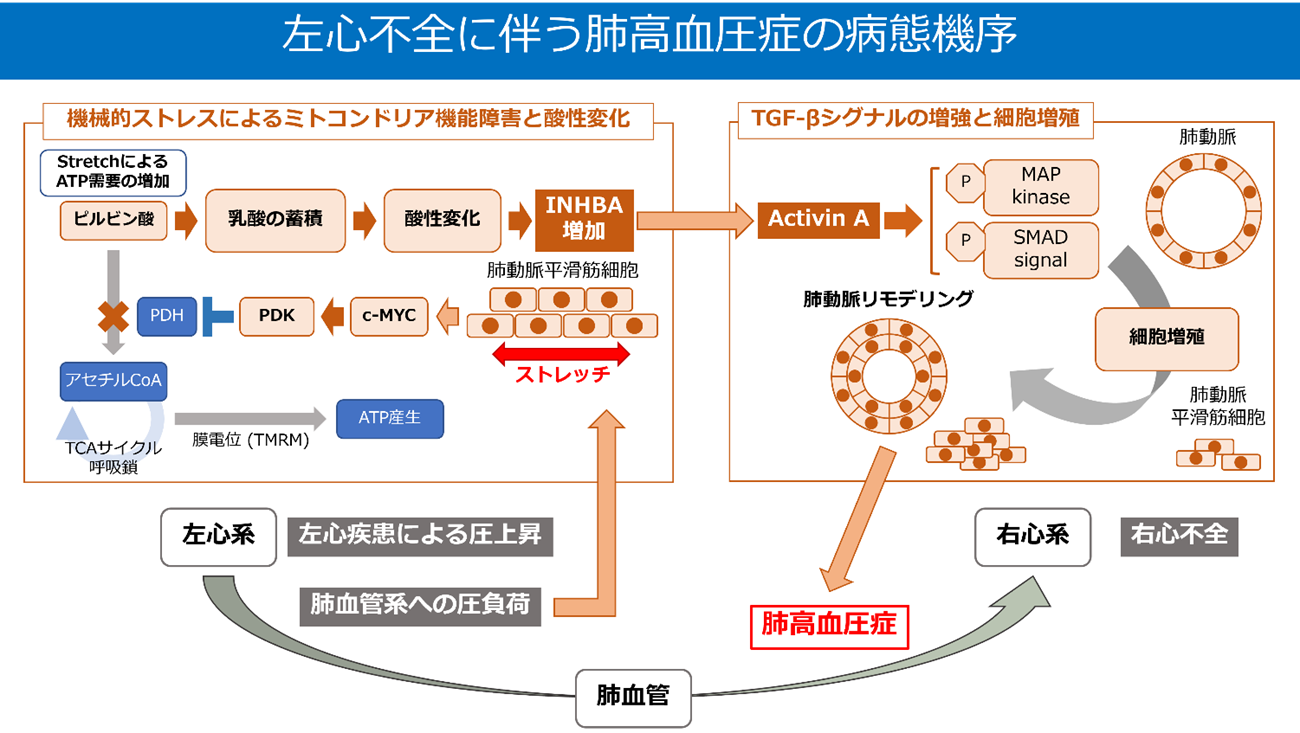
図1. 左心疾患に伴う肺高血圧症におけるINHBAの役割
<関連情報>
- https://www.tohoku.ac.jp/japanese/2026/02/press20260204-02-INHBA.html
- https://www.tohoku.ac.jp/japanese/newimg/pressimg/tohokuuniv-press20260204_web02_INHBA.pdf
- https://www.ahajournals.org/doi/10.1161/ATVBAHA.125.322506
肺動脈リモデリングの病態:第1群および第2群肺高血圧症におけるTGF-βシグナル伝達とインヒビンサブユニットβA Pathogenesis of Pulmonary Artery Remodeling: TGF-Beta Signaling and Inhibin Subunit Beta A in Group 1 and 2 Pulmonary Hypertension
Yusuke Yamada Taijyu Satoh, Nobuhiro Yaoita, Kaito Yamada, Naoki Chiba, Kohei Komaru, Kotaro Nochioka, …, and Satoshi Yasuda
Arteriosclerosis, Thrombosis, and Vascular Biology Published: 22 January 2026
DOI:https://doi.org/10.1161/ATVBAHA.125.322506
Abstract
BACKGROUND:
Pulmonary hypertension (PH) due to left heart disease (group 2 PH) is associated with a worse prognosis than isolated heart failure. Both pulmonary arterial hypertension (group 1 PH) and group 2 PH are involved in pulmonary artery (PA) remodeling, which is potentially driven by shared molecular mechanisms. The aim of this study was to investigate the underlying processes contributing to PA remodeling in group 2 PH.
METHODS:
To mimic the response to a left-sided pressure load, pulmonary arterial smooth muscle cells (PASMCs) were subjected to mechanical stretch. RNA sequencing of PAs from patients with group 2 PH was performed using the Gene Expression Omnibus database. Mice with transverse aortic constriction and spontaneously hypertensive rats were used as group 2 PH models, and they were treated with adeno-associated virus via intratracheal instillation.
RESULTS:
RNA sequencing of PASMCs after the stretch stress identified 1585 genes specifically upregulated in PASMCs from patients with group 1 PH. Further PA and plasma analyses from patients with group 2 PH, integrated with group 1 PH findings, identified enhancement of TGF-β (transforming growth factor-beta) signaling by the INHBA (inhibin subunit beta A) as a key feature. Metabolomics revealed that stretch-induced mitochondrial dysfunction in PASMCs caused lactic acidosis via enhancement of PDK1 (pyruvate dehydrogenase kinase 1) and c-MYC, leading to increased INHBA expression. Mice with transverse aortic constriction exhibited increased INHBA expression, decreased PDH (pyruvate dehydrogenase) expression, and acidic alterations in PAs. Targeted silencing of INHBA or PDK1 using adeno-associated virus in mice with transverse aortic constriction attenuated PA remodeling, improved right ventricular function, and reduced PH.
CONCLUSIONS:
Integrated RNA sequencing and metabolomics with stretched PASMCs and animal models identified mitochondrial dysfunction and subsequent acidic alterations as stimulators of increased INHBA expression and TGF-β signaling. These mechanisms contributed to PA remodeling in group 2 PH and provided potential therapeutic strategies.