2026-02-04 オックスフォード大学
<関連情報>
- https://www.ox.ac.uk/news/2026-02-04-new-analysis-deep-maniot-greeks-reveals-unique-genetic-time-capsule-balkans
- https://www.nature.com/articles/s42003-026-09597-9
ディープ・マニオットのギリシャ人の片親分析により、中世以前の時代からの遺伝的連続性が明らかになった Uniparental analysis of Deep Maniot Greeks reveals genetic continuity from the pre-Medieval era
Leonidas-Romanos Davranoglou,Athanasios Petros Kofinakos,Anargyros D. Mariolis,Göran Runfeldt,Paul Andrew Maier,Michael Sager,Panagiota Soulioti,Theodoros Mariolis-Sapsakos & Alexandros Heraclides
Communications Biology Published:04 February 2026
DOI:https://doi.org/10.1038/s42003-026-09597-9
Abstract
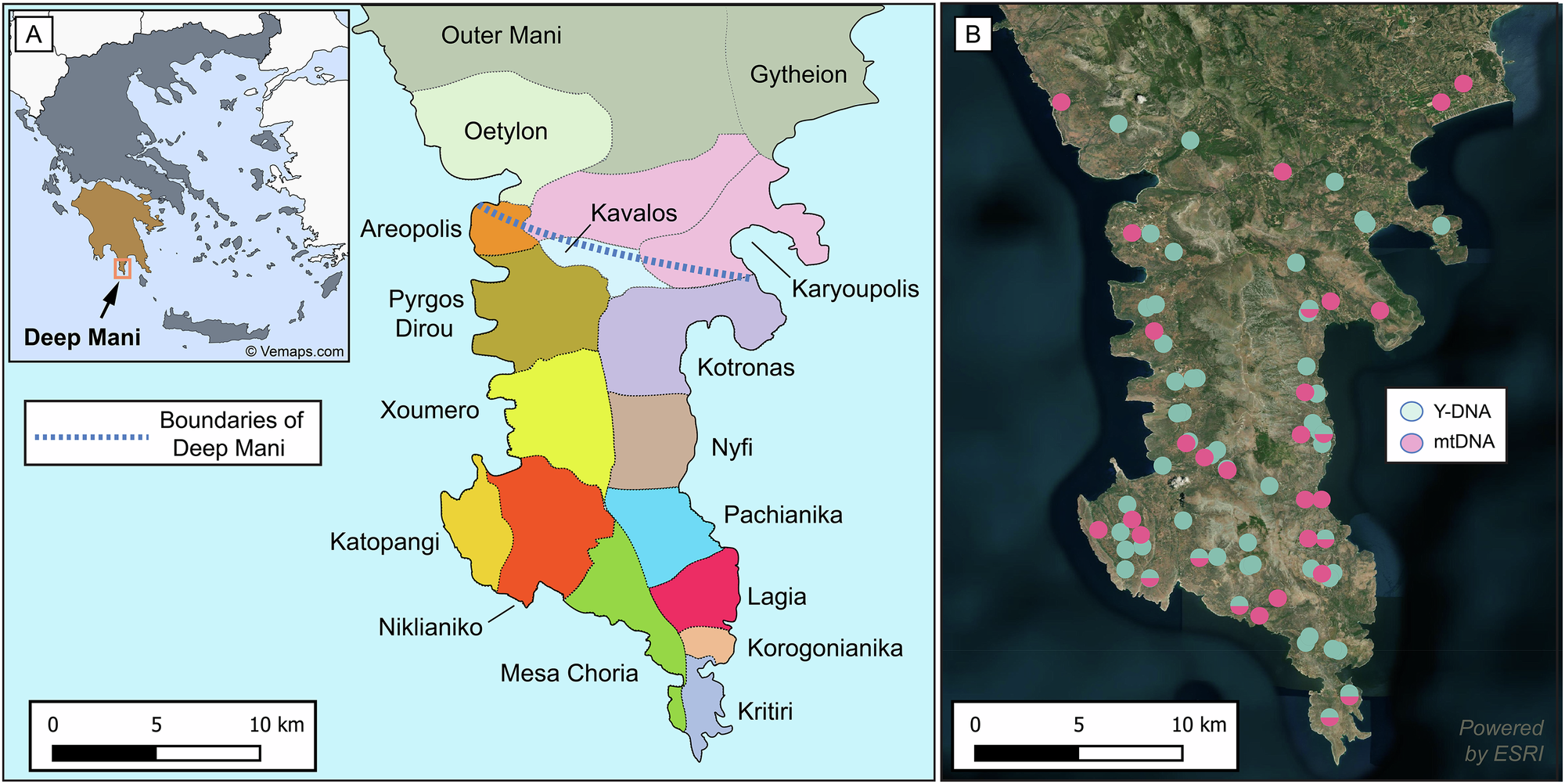
The Deep Maniots, an isolated population at the southernmost tip of mainland Greece, have drawn scholarly interest for their unique dialect, culture, and patrilineal clan structure. Geographically shielded by the Mani Peninsula, they are thought to have been minimally affected by 6th-century CE migrations that transformed Balkan demography. To investigate their genetic origins, we analysed Y-DNA and mtDNA from 102 Deep Maniots using next-generation sequencing. Paternally, Deep Maniots exhibit an exceptional prevalence (~80%) of West Asian haplogroup J-M172 (J2a), with subclade J-L930 accounting for ~50% of lineages. We identify Bronze Age Greek ancestry in Y-haplogroups nearly absent elsewhere, highlighting their longstanding genetic isolation. The absence of northeast European-related paternal lineages, common in other mainland Greeks, suggests preservation of southern Greece’s pre-Medieval genetic landscape. Y-haplogroup phylogeny reveals strong founder effects dated to ~380–670 CE, while the emergence of clan-based social structure is estimated around 1350 CE, centuries earlier than previously thought. In contrast, maternal lineages display greater heterogeneity, primarily originating from ancient Balkan, Levantine, and West Eurasian sources. These results align with historical and anthropological accounts, showcasing Deep Maniots as a genetic snapshot of pre-Medieval southern Greece, offering new perspectives on population continuity and mobility in the Late Antique eastern Mediterranean.