2026-02-04 国立遺伝学研究所
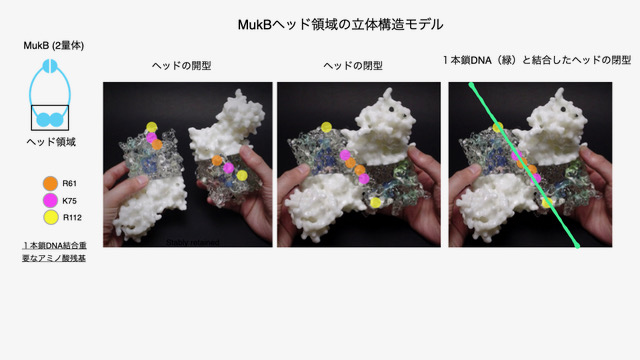
MukBのリングが閉じるとセンサー残基が整列し一本鎖DNA結合領域を形成する。一本鎖DNAがリング内に入ると安定に保持され、二本鎖DNAの場合は再度放出される。
<関連情報>
- https://www.nig.ac.jp/nig/ja/2026/02/research-highlights_ja/rh20260204.html
- https://www.nature.com/articles/s42003-025-09345-5
細菌SMCタンパク質MukBの内表面残基がin vitroでのssDNA結合に関与する Involvement of the inner surface residues of bacterial SMC protein MukB in the ssDNA binding in vitro
Koichiro Akiyama,Koichi Yano & Hironori Niki
Communications Biology Published:16 December 2025
DOI:https://doi.org/10.1038/s42003-025-09345-5
Abstract
The bacterial condensin MukB facilitates proper chromosome segregation in Escherichia coli. MukB protein localizes at the ori adjacent region by unknown mechanism. The MukB protein entraps the single-stranded DNA (ssDNA) molecule more efficiently than double-stranded DNA (dsDNA). In the bacterial genome, several copies of the rrn genes are encoded near the ori region. The rrn regions are expected to efficiently generate ssDNA due to their high transcriptional activity and the frequent formation of R-loops. In this study, we identified residues involved in DNA binding. The mutations impaired ssDNA binding more severely than dsDNA binding in vitro, and also caused deficiencies in cell growth and nucleoid segregation. These amino acid residues are aligned and are thought to bind DNA when the MukB dimer entraps a DNA molecule within its ring, thereby likely enhancing the DNA-binding activity of MukB. These residues may contribute to the accumulation of MukB on the chromosome, including the rrn regions.