2026-02-05 京都大学iPS細胞研究所
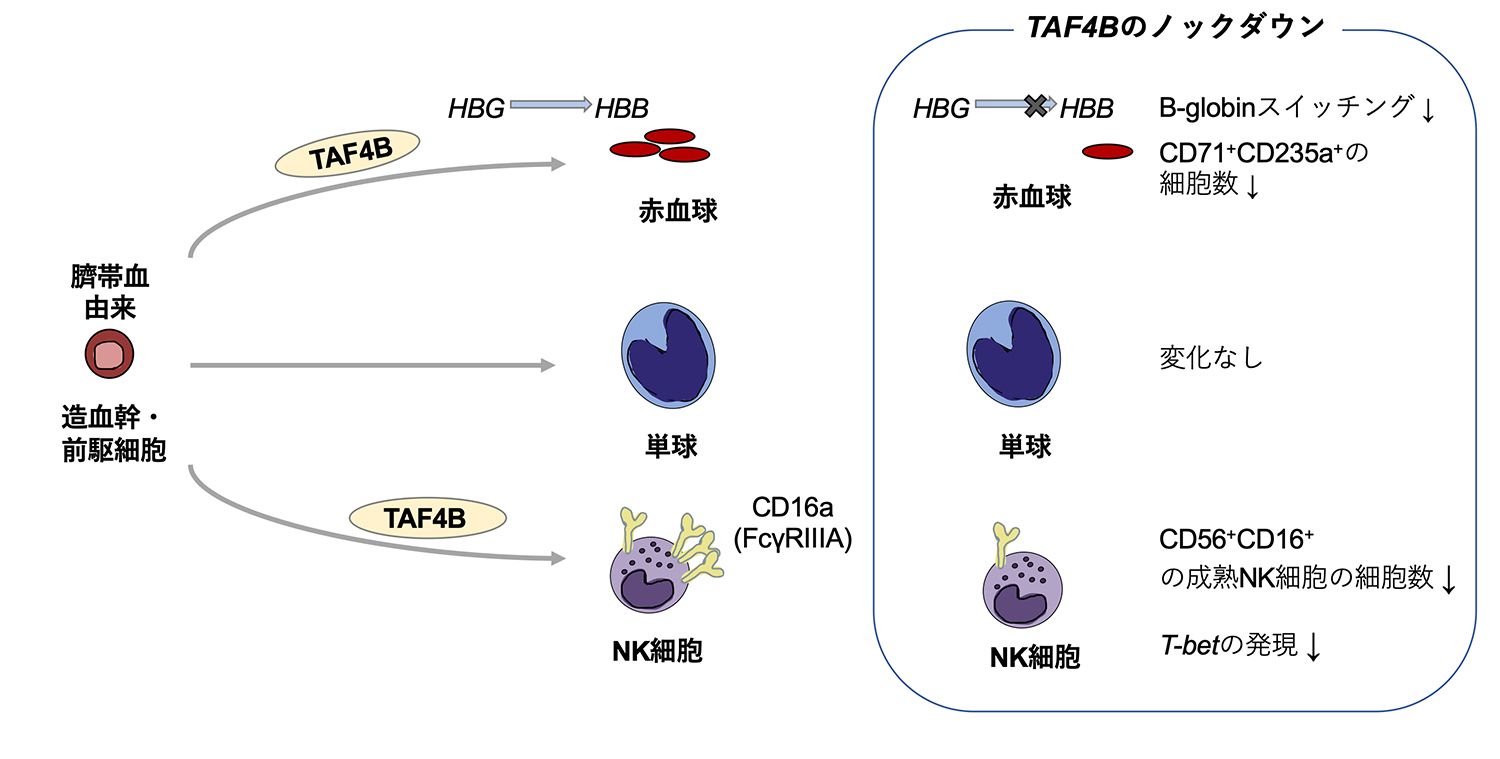
論文の概要図
<関連情報>
- https://www.cira.kyoto-u.ac.jp/j/pressrelease/news/260205-150000.html
- https://www.sciencedirect.com/science/article/abs/pii/S0006291X25018492
TAF4Bノックダウンは赤血球系細胞とナチュラルキラー細胞に異なる影響を与えるが、ヒト臍帯血HSPCからの単球分化には影響を与えない TAF4B knockdown differentially affects erythroid and natural killer cells but not monocytic differentiation from human cord blood HSPCs
Saori Nakano, Akira Niwa, Yohko Kitagawa, Megumu K. Saito
Biochemical and Biophysical Research Communications Available online: 15 December 2025
DOI:https://doi.org/10.1016/j.bbrc.2025.153133
Highlights
- We performed shRNA-mediated TAF4B knockdown in human cord blood Lin–CD34+ HSPCs.
- TAF4B loss reduces CFU-Mix and erythroid output, with selective HBB downregulation.
- Monocytic differentiation from human HSPCs remains intact under TAF4B knockdown.
- TAF4B knockdown impairs CD16 acquisition and lowers TBX21 during NK cell maturation.
Abstract
Hematopoietic stem and progenitor cells (HSPCs) rely on coordinated transcriptional programs, yet lineage-specific functions of general transcription machinery components remain unclear. We examined the contribution of TATA-binding protein–associated factor 4B (TAF4B) in human cord blood–derived Lin–CD34+ HSPCs using shRNA-mediated knockdown across colony-forming unit (CFU) assays and directed differentiation. TAF4B knockdown reduced CFU-Mix output, whereas BFU-E and CFU-GM were unchanged. In directed erythroid culture, the proportion of CD71+CD235a+ cells was preserved, but total erythroid cell numbers and HBB transcripts decreased, while HBG and GATA1/KLF1/BCL11A mRNA remained unchanged. In monocytic differentiation, CD14+CD11b+ fractions and counts were not affected. During NK cell differentiation, CD56+ frequency was maintained, but the number and proportion of CD16+ cells declined, accompanied by reduced TBX21 with minimal change in EOMES. These findings indicate lineage- and stage-dependent sensitivity to partial TAF4B perturbation, with unresolved causality and mechanisms requiring orthogonal genetic and chromatin-focused studies.