
2026-02-10 アメリカ国立衛生研究所(NIH)
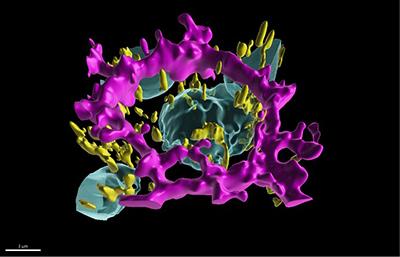
Representative image of a polarized iRPE cell. Phalloidin staining shows cell borders (magenta), Hoechst labels nuclei (cyan), while TOMM20 tagged with mEGFP was used to visualize mitochondria (yellow).
<関連情報>
- https://www.nih.gov/news-events/news-releases/nih-scientists-develop-digital-twin-eye-cells-understand-treat-age-related-macular-degeneration
- https://www.nature.com/articles/s44387-026-00074-6
AI駆動型3D細胞内RPEマップは、頂基底極性の確立における細胞状態遷移を発見する AI driven 3D subcellular RPE map discovers cell state transitions in establishment of apical-basal polarity
Davide Ortolan,Pushkar Sathe,Andrei Volkov,Dominik Reichert,Sheldon Sebastian,Arvydas Maminishkis,Nicholas J. Schaub,Bengt Ljungquist,Devika Bose,Jorge Ferrari,Nyusha Lin,Gianluca Pegoraro,Carl G. Simon Jr,Ruchi Sharma,Peter Bajcsy & Kapil Bharti
npj Artificial Intelligence Published:06 February 2026
DOI:https://doi.org/10.1038/s44387-026-00074-6
Abstract
The retinal pigment epithelium (RPE) is a specialized cell monolayer that forms the barrier between the subretinal and choroidal spaces. During development, RPE cells polarize perpendicular to the monolayer plane such that organelles attain specific intracellular locations. This allows the RPE to differentially interact with overlying photoreceptors and underlying choriocapillaris. When RPE polarity is disrupted, tissue homeostasis is disturbed, leading to retinal degeneration. The subcellular organizational principles of RPE polarity are unknown. We developed an artificial intelligence (AI), specifically a mask region-based convolutional neural network-assisted high-content image analysis platform combined with mathematical modeling to develop a quantitative three-dimensional digital twin of RPE subcellular structures during the establishment of apical/basal polarity, polarity organization with learning-based analysis for RPE image segmentation (POLARIS). We discovered, during apical/basal polarization, cells constrict along the lateral axis and elongate apically, nuclear volume decreases, nuclear envelope develops invaginations, junctional complexes consolidate to the lateral membrane, the endoplasmic reticulum and mitochondria increase in volume and translocate towards the nucleus, and lysosomes move towards the central-apical side. AI algorithm and mathematical analysis reveal non-stochastic cell state transitions and organelle interactions in 3D during RPE polarization. These integrated AI-based quantitative data provide a reference digital twin to discover intracellular defects in diseased RPE.

