2026-02-12 東北大学
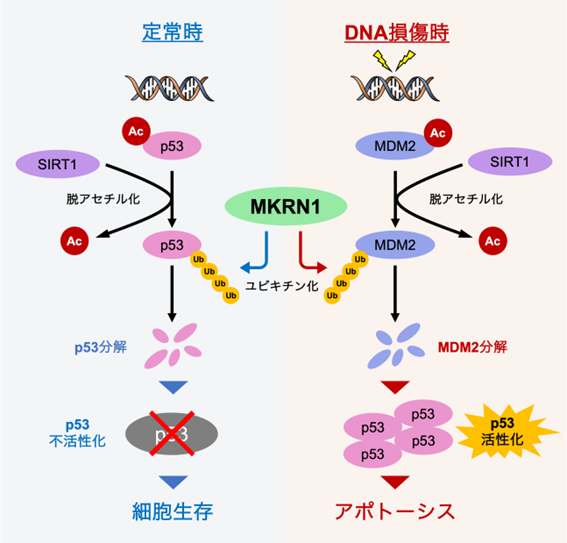
図1. MKRN1によるp53-MDM2制御系の調節機構
<関連情報>
- https://www.tohoku.ac.jp/japanese/2026/02/press20260212-01-p53.html
- https://www.nature.com/articles/s41418-026-01662-4
p53-MDM2フィードバックループの重要な調節因子としてのMKRN1の同定 Identification of MKRN1 as a key modulator of the p53-MDM2 feedback loop
Tatsuya Shimada,Takuya Noguchi,Ryuto Komatsu,Kohei Otani,Takaya Komatsu,Sara Suzuki,Maki Mitsuya,Takumi Okubo,Ryo Ito,Mayuka Yamada,Yusuke Hirata & Atsushi Matsuzawa
Cell Death & Differentiation Published:30 January 2026
DOI:https://doi.org/10.1038/s41418-026-01662-4
Abstract
The p53-murine double minute 2 (MDM2) feedback loop plays a central role in tumor suppression by optimizing p53-dependent DNA damage responses (DDRs), though it has been suggested that factors other than MDM2 are also involved in the regulation of the p53-MDM2 feedback loop. We identified makorin ring finger protein 1 (MKRN1) as a novel ubiquitin E3 ligase that ubiquitinates MDM2 and thereby promotes the p53 activation. As previously demonstrated, MKRN1 ubiquitinates and degrades p53 under steady-state conditions. However, when DNA damage occurs, MKRN1 switches its substrate to MDM2. Thereafter, MKRN1 promotes the stabilization and activation of p53 through proteasomal degradation of MDM2, which contributes to the elimination of DNA-damaged cells. Moreover, we found that the switch in the substrate of MKRN1 was determined by the NAD(+)-dependent protein deacetylase Sirtuin-1 (SIRT1). Thus, our results suggest that MKRN1 working in conjunction with SIRT1 is a master regulator of the p53-MDM2 feedback loop modulated by crosstalk between ubiquitination and acetylation.