
2026-02-13 英国研究イノベーション機構(UKRI)
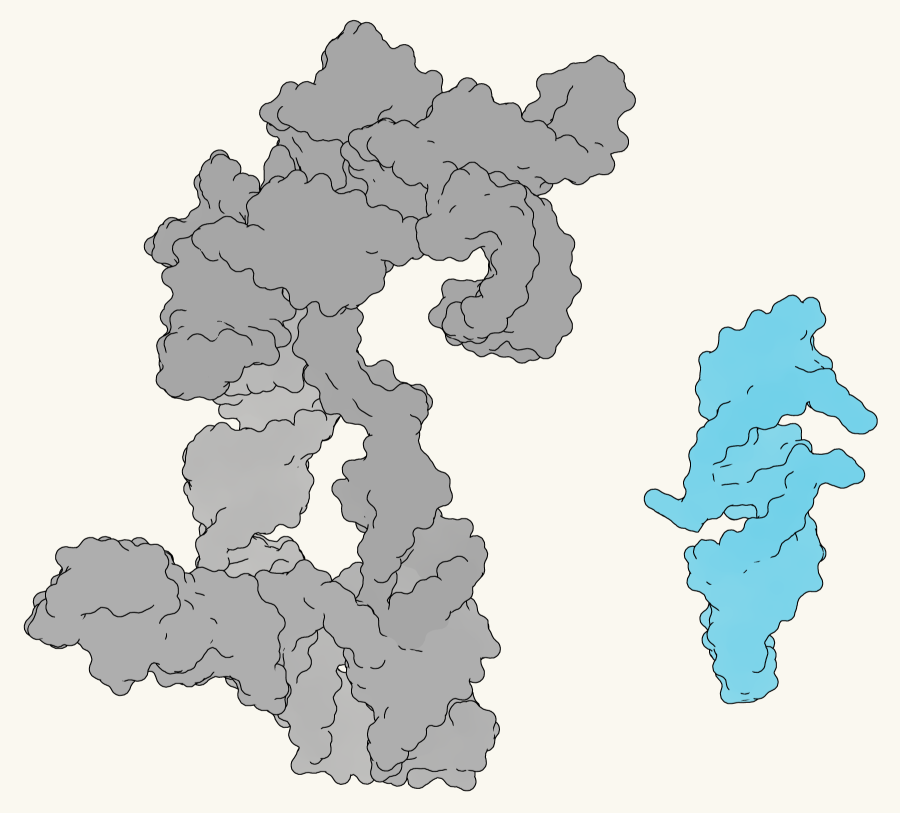
Previously discovered large RNA polymerase ribozyme structure (grey, based on pdb: 8T2P) vs. newly discovered small RNA polymerase ribozyme QT45 (blue, AlphaFold3 prediction). Credit: Edoardo Gianni
<関連情報>
- https://www.ukri.org/news/scientists-chemical-breakthrough-sheds-light-on-origins-of-life/
- https://www.science.org/doi/10.1126/science.adt2760
自身とその相補鎖を合成できる小さなポリメラーゼリボザイム A small polymerase ribozyme that can synthesize itself and its complementary strand
Edoardo Gianni, Samantha L. Y. Kwok, Christopher J. K. Wan, Kevin Goeij, […] , and Philipp Holliger
Science Published:12 Feb 2026
DOI:https://doi.org/10.1126/science.adt2760
Abstract
The emergence of a chemical system capable of self-replication and evolution is a critical event in the origin of life. RNA polymerase ribozymes can replicate RNA, but their large size and structural complexity impede self-replication and preclude their spontaneous emergence. Here we describe QT45: a 45-nucleotide polymerase ribozyme, discovered from random sequence pools, that catalyzes general RNA-templated RNA synthesis using trinucleotide triphosphate (triplet) substrates in mildly alkaline eutectic ice. QT45 can synthesize both its complementary strand using a random triplet pool at 94.1% per-nucleotide fidelity, and a copy of itself using defined substrates, both with yields of ~0.2% in 72 days. The discovery of polymerase activity in a small RNA motif suggests that polymerase ribozymes are more abundant in RNA sequence space than previously thought.

