2026-02-18 ノースウェスタン大学
<関連情報>
- https://news.northwestern.edu/stories/2026/02/living-mini-brains-meet-next-generation-bioelectronics
- https://www.nature.com/articles/s41551-026-01620-y
神経オルガノイドを完全にカバーし、高解像度の電気生理学を観察するための形状適合多孔質フレームワーク Shape-conformal porous frameworks for full coverage of neural organoids and high-resolution electrophysiology
Naijia Liu,Shahrzad Shiravi,Tianqi Jin,Jiaqi Liu,Zhengguang Zhu,Jiying Li,Ingrid Cheung,Haohui Zhang,Yue Wang,Qingyuan Li,Zijie Xu,Liangsong Zeng,Maria Jose Quezada,Andres Villalobos,Yasaman Samei,Shreyaa Khanna,Shuozhen Bao,Mingzheng Wu,Sida Liang,Xu Cheng,Zengyao Lv,Woo-Youl Maeng,Yamin Zhang,Haiwen Luan,… John A. Rogers
Nature Biomedical Engineering Published:18 February 2026
DOI:https://doi.org/10.1038/s41551-026-01620-y
Abstract
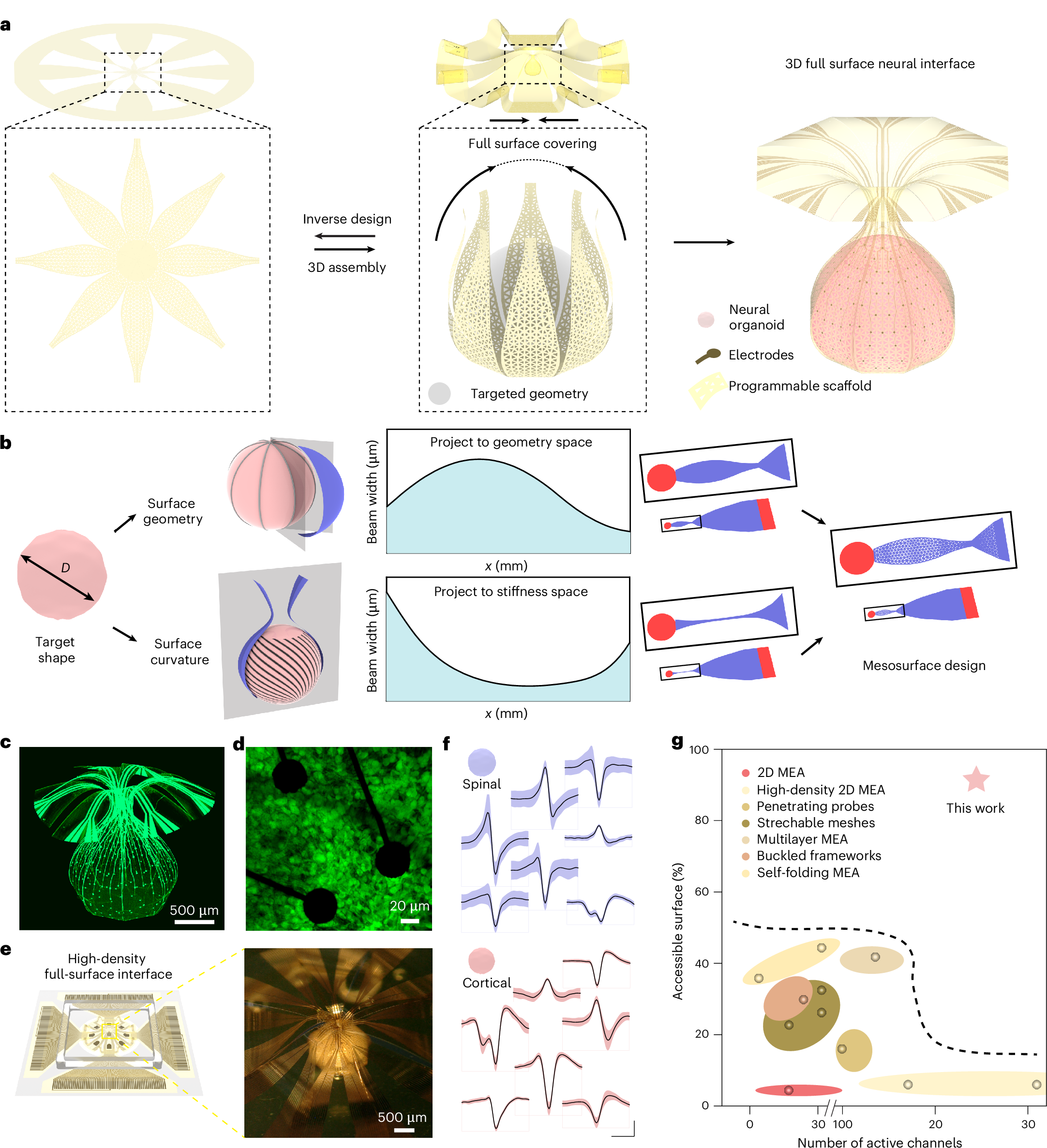
Human neural organoids are essential platforms for fundamental and applied research due partly to their complex, three-dimensional neuronal circuit geometries. Standard and recently developed neural interface technologies have shortcomings in their ability to electrically characterize and control neural activity in these systems, owing to their limited accessibility to neuron populations and microelectrode densities. Here we report a shape-matched, soft, three-dimensional mesoscale framework with nearly full surface coverage to neural organoids that supports high channel count interfaces for precision electrophysiology and programmed electrical stimulation. The neural interface is designed via inverse modelling techniques and self-assembles three-dimensionally around the organoids. Three-dimensional reconstruction of neural activities allows high-resolution spatial electrophysiology to reveal network-level characteristics in neural organoids. The porous framework offers options for simultaneous fluorescence imaging, localized optogenetic neuromodulation, longitudinal monitoring, pharmacological evaluations and modelling of neural disease phenotypes, demonstrating broad applicability for studies of human-derived cortical and spinal organoids.