2026-02-24 国立長寿医療研究センター
<関連情報>
- https://www.ncgg.go.jp/ri/report/20260210.html
- https://www.sciencedirect.com/science/article/pii/S0531556526000185
オープン性と誠実性が高いほど、長期介護リスクが低い:日本の地域在住高齢者の22年間の追跡調査 Higher openness and conscientiousness are associated with lower risk of long-term care needs: A 22-year follow-up of community-dwelling older adults in Japan
Yukiko Nishita, Chikako Tange, Sayaka Kubota, Shu Zhang, Mana Tateishi, Fujiko Ando, Hiroshi Shimokata, Rei Otsuka
Experimental Gerontology Available online: 20 January 2026
DOI:https://doi.org/10.1016/j.exger.2026.113040
Highlights
- Personality traits were prospectively examined in relation to long-term care (LTC) needs over a 21.8-year follow-up.
- Higher openness and conscientiousness were significantly associated with reduced risk of LTC needs.
- Higher openness and conscientiousness may protect autonomy and promote healthy aging in older adults.
Abstract
Background
Personality traits have been associated with physical and mental health outcomes, yet their relationship with long-term care (LTC) needs remains understudied.
Objective
To examine the longitudinal effect of personality traits on the incidence of LTC needs among community-dwelling older adults in Japan.
Methods
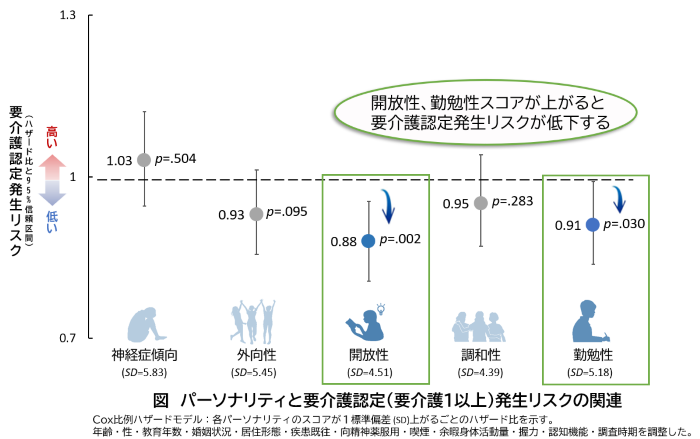
Data were drawn from the National Institute for Longevity Sciences–Longitudinal Study of Aging (NILS-LSA), involving 1003 older adults (≥65 years; mean age 73.0 ± 4.4; 48.6% male), who had no certification of LTC needs prior to baseline or within two years after baseline to prevent reverse causality. Personality traits were assessed at baseline using the Japanese version of the NEO Five-Factor Inventory. Participants were followed for up to 21.8 years (mean ± SD: 12.2 ± 5.7 years) to determine the incidences of long-term care (LTC) needs by the LTC Insurance System certificate. Cox proportional hazards models were used to estimate hazard ratios for the incidence of long-term care (LTC) needs per one standard deviation (1-SD) increase in each personality trait score, adjusting for relevant covariates.
Results
During follow-up, 583 individuals (58.1%) were newly certified for LTC needs. Higher levels of openness and conscientiousness were associated with reduced LTC needs incidence (HR [95% CI] 0.88 [0.81–0.95], p = 0.002; 0.91 [0.84–0.99], p = 0.030, respectively). No significant associations were found for neuroticism, extraversion, or agreeableness.
Conclusion
Among older adults living in the community, higher openness and conscientiousness were protective against future LTC needs. These findings highlight the potential role of psychological traits in promoting autonomy and healthy aging.