2026-02-24 ノースウェスタン大学
<関連情報>
- https://news.northwestern.edu/stories/2026/02/trashing-cancers-undruggable-proteins
- https://www.nature.com/articles/s41467-026-68913-3
MYCおよびKRASを標的とした分解のためのヘテロ二機能性タンパク質模倣ポリマー Heterobifunctional proteomimetic polymers for targeted degradation of MYC and KRAS
Max M. Wang,Mihai I. Truica,Brayley S. Gattis,Julia Oktawiec,Vinay Sagar,Ananya A. Basu,Paul A. Bertin,Xiaoyu Zhang,Sarki A. Abdulkadir & Nathan C. Gianneschi
Nature Communications Published:24 February 2026
DOI:https://doi.org/10.1038/s41467-026-68913-3
Abstract
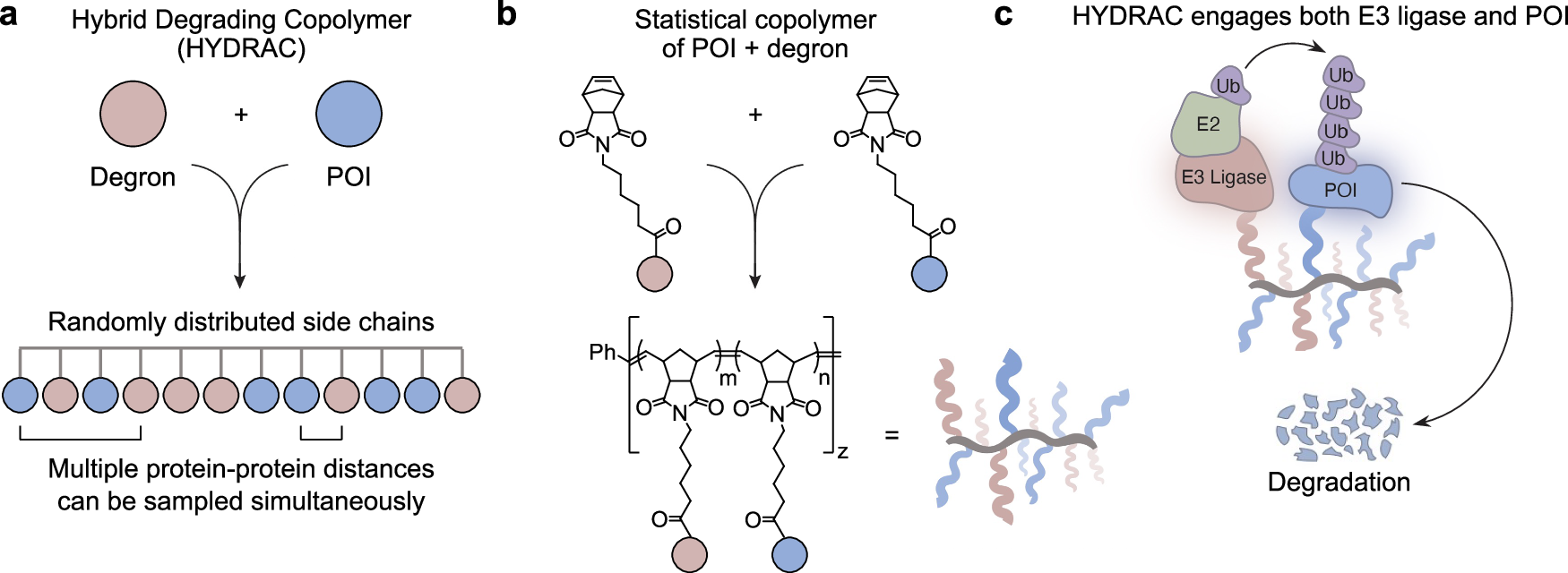
Targeted protein degradation (TPD) has enabled modulation of previously undruggable proteins. However, existing small-molecule approaches require arduous optimization and are largely confined to targets bearing ligandable pockets. To address these challenges, we introduce the HYbrid DegRAding Copolymer (HYDRAC), a polymeric platform that integrates target‑binding peptides with peptide-based or small‑molecule degrons to orchestrate selective degradation of disease‑relevant proteins. HYDRACs are amenable to scalable synthetic methods, exhibit broad structural tunability, and support multivalent payload conjugation. This intrinsic modularity enables incorporation of a diverse repertoire of target‑binding motifs and E3‑ligase recruiters. These include von Hippel-Lindau protein (VHL), Kelch-like ECH-associated protein 1 (KEAP1), and Cereblon (CRBN). We deploy HYDRACs against two historically intractable targets, Myelocytomatosis proto-oncogene (MYC) and Kirsten rat sarcoma viral oncogene homolog (KRAS), achieving potent degradation in vitro and durable tumor suppression in murine models. Notably, HYDRACs bearing consensus RAS-binding motifs effectuate degradation of KRAS across multiple alleles, suggesting pan‑KRAS potential. We envision HYDRACs as a generalizable paradigm that substantially expands the TPD armamentarium.