2026-02-27 北海道大学,富山大学
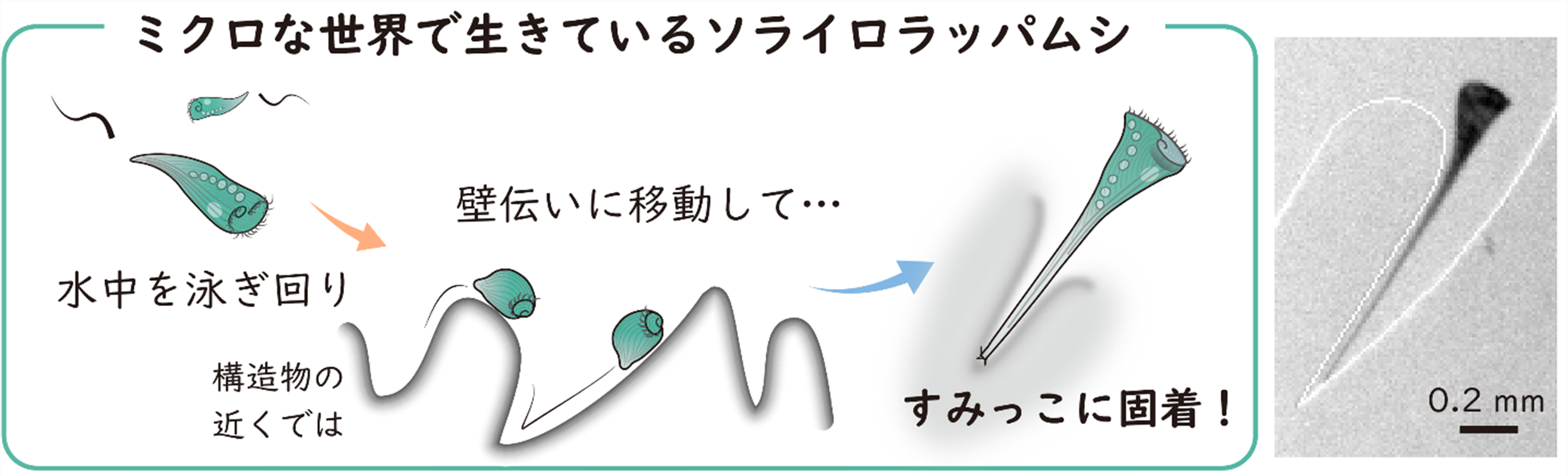
すみっこ固着を実現するプロセス(左)とすみっこに固着したソライロラッパムシの顕微鏡写真(右)
<関連情報>
- https://www.hokudai.ac.jp/news/2026/02/post-2199.html
- https://www.hokudai.ac.jp/news/pdf/260227_pr3.pdf
- https://www.pnas.org/doi/10.1073/pnas.2518816123
単細胞生物ソライロラッパムシにおける固着場所の幾何選好性 Geometrical preference of anchoring sites in the unicellular organism Stentor coeruleus
Syun Echigoya, Takuya Ohmura, Katsuhiko Sato, +1 , and Yukinori Nishigami
Proceedings of the National Academy of Sciences Published:February 25, 2026
Significance
Animals use various natural structures as landmarks for navigation. In microorganism habitats, microsediments also form geometrically complex environments. Is there a relationship between the geometrical features of structures and the behavior in unicellular organisms lacking visual cues? Here, we report that the free-swimming unicellular organism Stentor coeruleus selects the anchoring sites based on the surrounding shapes. Further observations and numerical simulations reveal that an asymmetric morphological change causes a temporary switch from ballistic to wall-following exploration, driven by surrounding structures. These results indicate that one simple behavioral response underlies the preference of anchoring sites with specific geometrical features in non-neural unicellular organisms. The findings shed light on the role of microenvironmental geometry in forming ecological niches for microorganisms.
Abstract
Organisms often inhabit environments comprising complex structures across various scales. Animals rely on visual information from surrounding geometrical structures for navigation. Even at the microscale, various microsediments form complex structures in microbial habitats. The movement of microorganisms is passively affected by collisions and hydrodynamic interactions with surrounding structures. However, the influence of microenvironmental geometry on behavioral changes of unicellular organisms that lack visual perception remains unclear. Here, we developed geometrically structured chambers to investigate anchoring site preferences in the swimming ciliate Stentor coeruleus. Our experiments revealed that S. coeruleus preferentially anchored in narrow regions characterized by specific geometrical features, including corner angle, depth, and curvature at the corner end. Before anchoring, free-swimming S. coeruleus changed its behavior to move along the boundary wall of the chambers, accompanied by Ca2+-induced asymmetrical body deformation. To further investigate how S. coeruleus moves along the wall continuously, we conducted a hydrodynamic simulation and revealed that the asymmetric morphology causes asymmetric propulsive forces, explaining wall-following behavior through physical interactions with a wall. Thus, morphological change near a wall causes wall-following behavior, facilitating the identification of these narrow anchoring sites. Our findings indicate that environmental geometry drives behavioral transitions in S. coeruleus through simple biophysical processes, enabling spatial selection without visual cues. Overall, these results suggest that microgeometry plays a key role in shaping ecological niches for unicellular microorganisms.