2026-03-02 医薬基盤・健康・栄養研究所
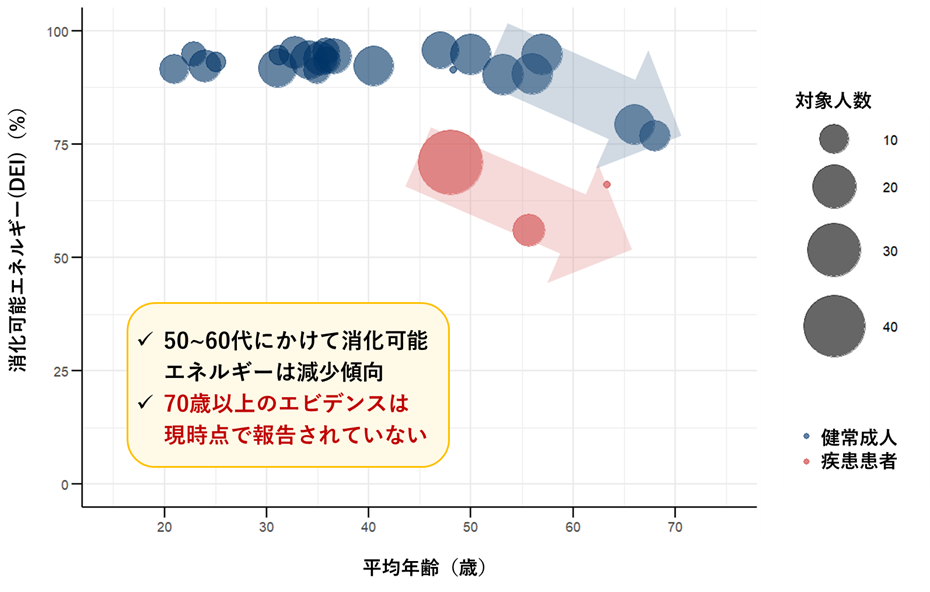
図. 各研究の平均年齢別にみた消化可能エネルギー平均値のプロット
<関連情報>
- https://www.nibn.go.jp/pr/press/2026-0227-1733-73.html
- https://www.sciencedirect.com/science/article/pii/S2161831326000116
ヒトにおける消化・代謝エネルギー摂取量:系統的レビュー Digestible and Metabolizable Energy Intake in Humans: a Systematic Review
Eiichi Yoshimura, Naoya Oi, Kanon Abe, Yuki Nishida
Advances in Nutrition Available online: 6 February 2026
DOI:https://doi.org/10.1016/j.advnut.2026.100597
Abstract
Understanding digestible energy intake (DEI) and metabolizable energy intake (MEI) is essential for elucidating human energy balance. The absolute of DEI refers to gross energy intake minus fecal energy loss (EL), whereas MEI further accounts for urinary EL. This systematic review aimed to synthesize the findings from studies that utilized bomb calorimetry to measure DEI and/or MEI (PROSPERO CRD42021230982). Medical Literature Analysis and Retrieval System Online (via PubMed), the Cochrane Library, Cumulative Index to Nursing and Allied Health Literature, and Scopus were searched for articles published between January 1973 and July 2024. Human studies (adults aged ≥18 y) were included without restrictions on study design. Data were descriptively summarized according to dietary conditions, including overeating, undereating, high-fiber diets, tree nut intake, time-restricted eating (TRE), medication use, and disease status. Twenty-three studies were included. Overeating generally increased absolute fecal ELs; however, proportional DEI and MEI remained relatively stable, suggesting adaptive responses. High-fiber diets and tree nut intake consistently lowered the proportions of DEI and MEI, indicating that dietary composition affects energy absorption efficiency. Results for TRE were inconsistent, with 1 study showing increased fecal EL and another reporting no significant changes. Aging and disease, particularly short bowel syndrome and home parenteral nutrition dependence, were associated with markedly reduced proportions of DEI and MEI. Despite methodological variability across studies, this review highlighted that both dietary quantity and composition significantly influence energy absorption. Furthermore, limited evidence suggested that aging and diseases impair energy absorption. Future studies using standardized protocols and randomized controlled trials are warranted to clarify the determinants of DEI and MEI across diverse populations.