2026-03-09 東京大学
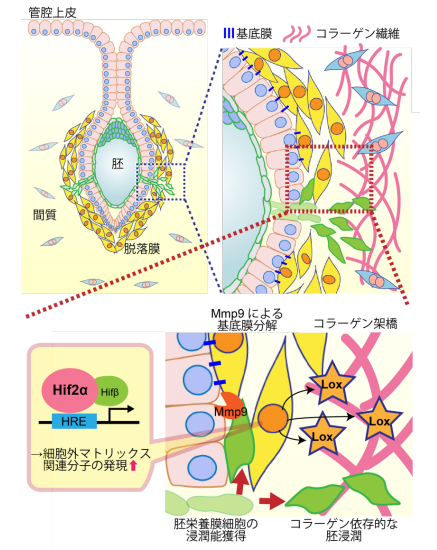
Lox による胚浸潤制御
<関連情報>
- https://www.h.u-tokyo.ac.jp/press/20260309.html
- https://www.h.u-tokyo.ac.jp/press/__icsFiles/afieldfile/2026/03/09/release_20260309_1.pdf
- https://www.nature.com/articles/s41419-026-08485-8
HIF2α誘導リシルオキシダーゼは胎児母体界面のコラーゲンをリモデリングすることで妊娠の成功を守る HIF2α-induced lysyl oxidase safeguards successful pregnancy by remodelling collagens at the feto-maternal interface
Shizu Aikawa,Ryoko Shimizu-Hirota,Akihiko Sakashita,Xueting He,Daiki Hiratsuka,Chihiro Ishizawa,Rei Iida,Yamato Fukui,Takehiro Hiraoka,Mitsunori Matsuo,Norihiko Takeda,Masahito Ikawa,Yutaka Osuga & Yasushi Hirota
Cell Death & Disease Published:09 March 2026
DOI:https://doi.org/10.1038/s41419-026-08485-8
Abstract
During the initial stage of gestation, precise constructions of the microenvironment at the feto-maternal interface are critical for successful embryonic development to term. It consists of the fetal placenta and the maternal decidua, contributing to favorable pregnancy outcomes and long-term health in both mother and child. Remarkably, although our previous work demonstrated that physiological uterine hypoxia promotes blastocyst implantation into the decidua basalis and onset of trophoblastic invasion via the hypoxia-inducible factor (Hif) signaling pathway, it remains unclear which key regulatory cascades are triggered underlying. Here, we harnessed recent advances of the spatial transcriptomic technology in combination with genetic mouse models to gain a more comprehensive understanding of physiological uterine hypoxia. We revealed that hypoxia-induced remodeling of the extracellular matrices (ECMs) allows the blastocyst-derived trophoblastic cells to invade into the uterine stroma upon implantation. Mechanistically, Hif2α drives the expression of lysyl oxidase (Lox) that crosslinks collagen I fibrils and their stabilization in the vicinity of the attached embryos. Uterine-specific knockout (uKO) of Hif2α and Lox compromised the process of embryo invasion, leading to female infertility. Collectively, our findings provide mechanistic insight into how hypoxia governs early embryonic invasion and contributes to successful pregnancy.
Key Points
- Hypoxia in the primary decidual zone induces Hif2α, which regulates lysyl oxidase (Lox) expression to remodel the extracellular matrix at the feto–maternal interface.
- Genetic disruption of Hif2α or Lox in the uterus impairs trophoblast invasion and compromises fertility, highlighting a critical hypoxia-driven signaling axis.
- Remodeling of the maternal decidual ECM network directly influences embryonic invasive capacity and subsequent placental formation, underscoring the importance of maternal tissue architecture in pregnancy outcomes.