2026-03-13 京都工芸繊維大学
<関連情報>
- https://www.kit.ac.jp/2026/03/news260313/
- https://www.kit.ac.jp/wp/wp-content/uploads/2026/03/news260313.pdf
- https://pubs.acs.org/doi/10.1021/acs.nanolett.5c05398
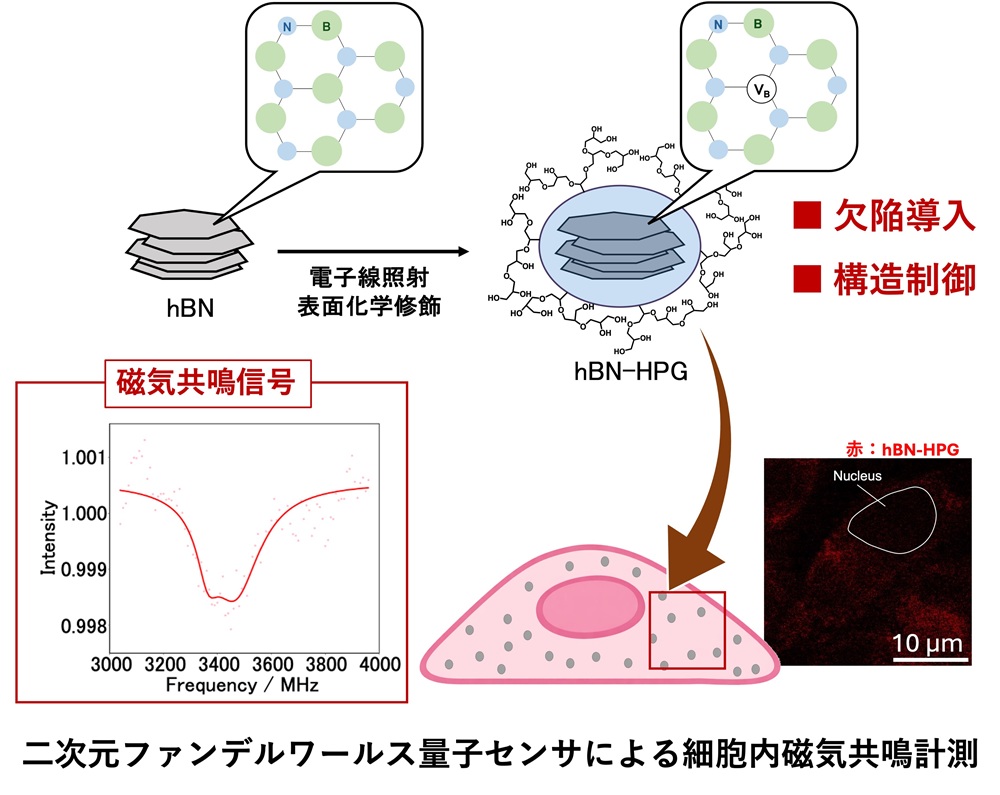
欠陥活性化および表面修飾された六方晶窒化ホウ素ナノ粒子を用いた細胞内量子センシング Defect-Activated and Surface-Modified Hexagonal Boron Nitride Nanoparticles toward Intracellular Quantum Sensing
Suzune Shimomura,Yurina Nakane,Hiroshi Abe,Yusuke Miyake,Takeshi Ohshima,Yumi Yoshida,Kohji Maeda,Takuma Sugi,and Shingo Sotoma
Nano Letters Published: March 12, 2026
DOI:https://doi.org/10.1021/acs.nanolett.5c05398
Abstract
van der Waals materials hosting spin defects have emerged as a new platform for solid-state quantum sensing. We report hexagonal boron nitride (hBN) nanoparticles containing negatively charged boron vacancy (VB–) centers that function as nanoscale quantum sensors. High-energy electron irradiation efficiently generated VB– centers, enabling clear optically detected magnetic resonance (ODMR) detection from nanoparticle ensembles. To improve dispersion and suppress nonspecific protein adsorption, we developed a two-step surface modification process using silica encapsulation followed by hyperbranched polyglycerol (HPG) grafting. The HPG coating enhanced colloidal stability and reduced nonspecific protein adsorption. ODMR thermometry revealed temperature-dependent frequency shifts with a thermal coefficient of approximately – 300 kHz/°C. Finally, we demonstrated proof-of-concept detection of ODMR signal in HeLa cells after uptake of the nanoparticles. These results establish VB–-containing hBN nanoparticles as promising nanoscale quantum sensors for future intracellular applications.