2026-03-13 京都大学
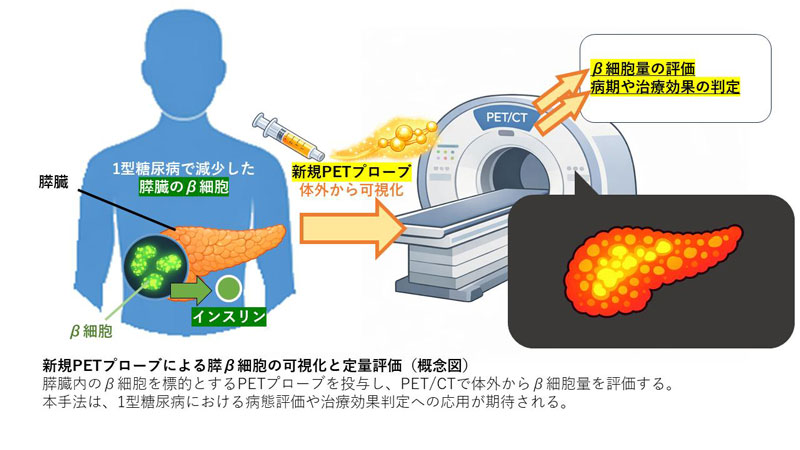
概念図作成:榊健太郎(京都大学)、一部素材は生成AI(ChatGPT-5.2)を用いて作成。
<関連情報>
- https://www.kyoto-u.ac.jp/ja/research-news/2026-03-13-1
- https://www.kyoto-u.ac.jp/sites/default/files/2026-03/web_2603_Sakaki-36d759d3e839760e9d8453333630c166.pdf
- https://diabetesjournals.org/diabetes/article/doi/10.2337/db25-1127/164564/Quantitative-Cell-Mass-Imaging-Redefines-Disease
定量的β細胞質量イメージングが1型糖尿病の病期分類と血糖コントロールを再定義 Quantitative β-Cell Mass Imaging Redefines Disease Staging and Glycemic Control in Type 1 Diabetes
Kentaro Sakaki;Takaaki Murakami;Hayao Yoshida;Daisuke Otani;Kanae Kawai Miyake;Yoichi Shimizu;Hiroyuki Fujimoto;Daisuke Yabe;Yuji Nakamoto;Nobuya Inagaki
Diabetes Published:March 12 2026
DOI:https://doi.org/10.2337/db25-1127
Noninvasive measurement of pancreatic β-cell mass remains an important unmet need in type 1 diabetes because conventional surrogate markers, such as C-peptide, often lack sensitivity in advanced disease. This study evaluated the glucagon-like peptide 1 receptor–targeted positron emission tomography tracer, 18F-labeled exendin-4–based probe conjugated with polyethylene glycol, [18F]FB(ePEG12)12-exendin-4 (18F-exendin-4), to determine its ability to visualize pancreatic β-cell mass. Positron emission tomography/computed tomography performed at 60 and 120 min after tracer injection in individuals with type 1 diabetes was compared with data from healthy control participants. No serious adverse events occurred. Pancreatic uptake was consistently lower in individuals with type 1 diabetes and showed clear separation between individuals with insulin-dependent diabetes and healthy control participants at 120 min. Pancreatic uptake at 120 min correlated with fasting C-peptide index and inversely with hemoglobin A1c and daily insulin dose per body weight. These findings support [18F]FB(ePEG12)12-exendin-4 positron emission tomography/computed tomography as a noninvasive approach for assessing β-cell mass and disease status.
Article Highlights
- We undertook this study to address the persistent need for noninvasive assessment of β-cell mass in type 1 diabetes.
- We aimed to determine whether 18F-exendin positron emission tomography/computed tomography can reliably visualize residual β-cell mass and distinguish stages of disease.
- We found that pancreatic tracer uptake was consistently reduced in type 1 diabetes, differentiated insulin-dependent patients from control participants, and aligned with markers of β-cell function and glycemic status.
- Our findings suggest that 18F-exendin imaging may offer fundamental platform for disease staging, therapeutic monitoring, and individualized care