2026-03-13 琉球大学

図1. マイクロコドラート法を用いた潜水調査の様子(桝井拓馬氏 提供)
<関連情報>
埋め立ては小規模な底生生物群集に影響を与えるのか?沖縄本島周辺のサンゴ礁における微小方形区調査 Does land reclamation affect small-scale benthic communities? Micro-quadrats on coral reefs around Okinawa Island, southern Japan
Dan Ishibashi,Giovanni Diego Masucci & James Davis Reimer
Marine Biodiversity Published:10 March 2026
DOI:https://doi.org/10.1007/s12526-026-01631-7
Abstract
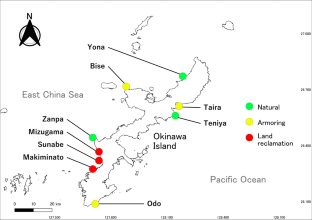
Coral reef ecosystems, such as those surrounding Okinawa Island, have high levels of biodiversity, especially among benthic communities. Over the last century, and particularly after World War II, major coastal development and reclamation works have been carried out along the coasts of Okinawa Island, and there are concerns about their adverse effects on the communities of organisms living in coral reef areas. Examples of methods for investigating the distribution and ecology of organisms that live on the seabed, as well as environmental impacts, include several transect and photo-quadrat techniques. However, such survey methods aim to roughly grasp the benthic biota at a spatial scale that does not target relatively small (< 5 cm) benthic organisms. Therefore, in this study, we focused on the microenvironment and conducted surveys of benthic organisms using quadrats of 0.0025 m2 (5 cm × 5 cm) (hereinafter referred to as micro-quadrats). Field surveys were conducted by scuba diving at nine coastal locations on Okinawa Island, where photographs were taken including the entire micro-quadrats (5 cm per side) in the field of view. In addition to the micro-quadrats, conventional transect (10 m length) methods were also used. Benthic coverage was calculated based on the data obtained by the identification, and the similarity of the biological communities was also compared. For the similarity comparison, we confirmed differences in community composition between sites and depending on the category of coastal development (natural, armoring, land reclamation). At the sites where reclamation had occurred, the coverage of octocorals was higher in the transect method, while the coverage of sand was highest in the micro-quadrats. In addition, significant differences were found in the community composition of organisms with the transect method and between the reclaimed and unreclaimed sites (p < 0.001). A similarly significant difference was found in the micro-quadrat method (p < 0.001). Transect results indicated that sites categorized as natural and armoring were characterized by hard coral or rock and rubble, while sites categorized as land reclamation were characterized by octocorals (mainly soft corals) or sand. In addition, micro-quadrat results indicated that sites categorized as natural or armoring were more likely to have hard coral, ascidian, and CCA, and that sites categorized as land reclamation were characterized as sand. Thus, depending on the method, the organisms and categories characterized at each site were also different. By focusing on more minute environments than conventional methods, this study demonstrates the importance of understanding the biota in microhabitats at different spatial scales.