2026-03-16 ブラウン大学
<関連情報>
- https://www.brown.edu/news/2026-03-16/braingate-rapid-communication
- https://www.nature.com/articles/s41593-026-02218-y
麻痺後の神経補綴装置による迅速かつ自然な両手タイピングの回復 Restoring rapid natural bimanual typing with a neuroprosthesis after paralysis
Justin J. Jude,Hadar Levi-Aharoni,Alexander J. Acosta,Shane B. Allcroft,Claire Nicolas,Bayardo E. Lacayo,Nicholas S. Card,Maitreyee Wairagkar,Alisa D. Levin,David M. Brandman,Sergey D. Stavisky,Francis R. Willett,Ziv M. Williams,John D. Simeral,Leigh R. Hochberg & Daniel B. Rubin
Nature Neuroscience Published:16 March 2026
DOI:https://doi.org/10.1038/s41593-026-02218-y
Abstract
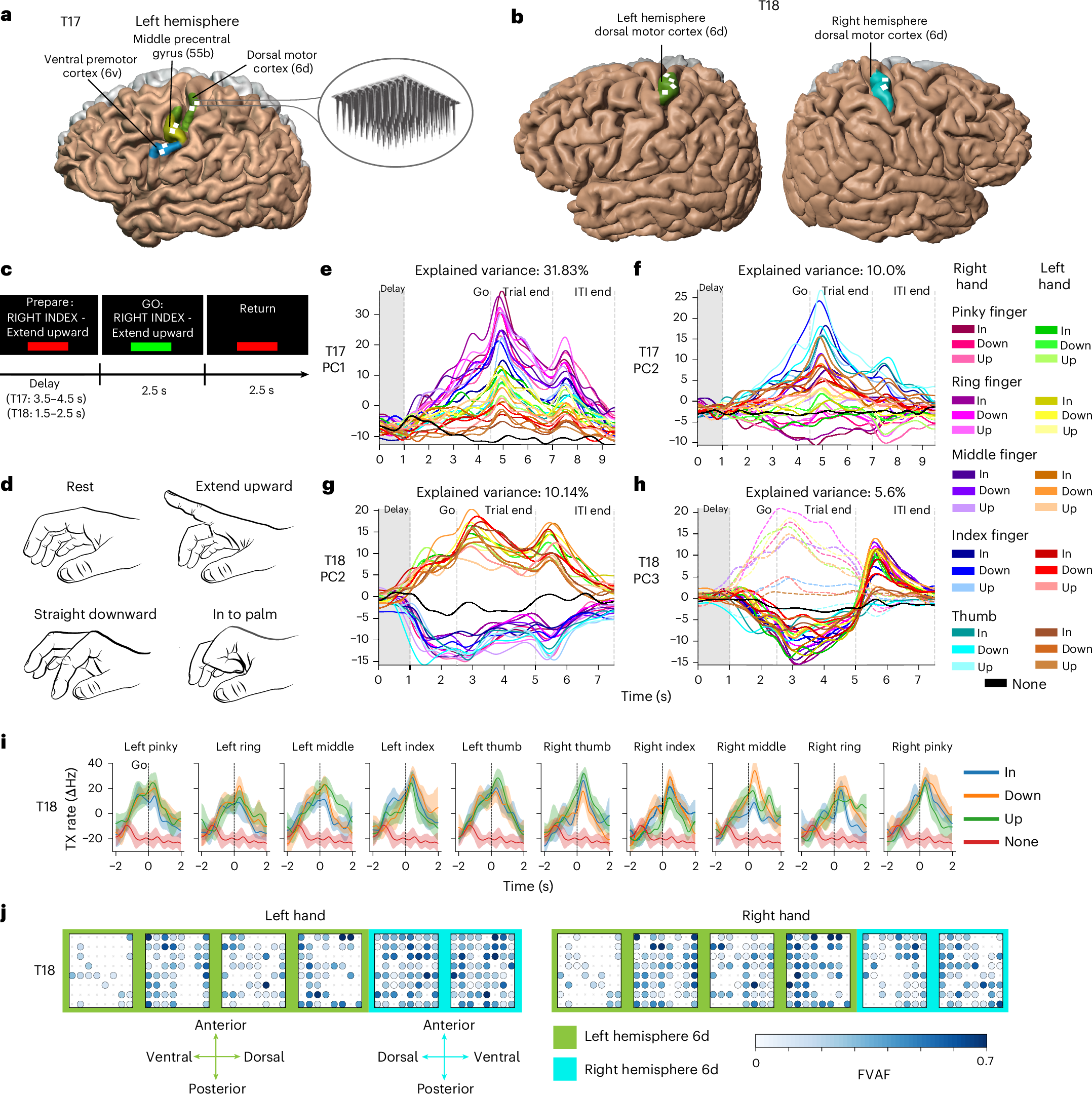
Here, recognizing keyboard typing as a familiar, high information rate communication paradigm, we developed an intracortical brain–computer interface (iBCI) typing neuroprosthesis providing bimanual QWERTY keyboard functionality for people with paralysis. Typing with this iBCI involves only attempted finger movements, which are decoded accurately with as few as 30 calibration sentences. Sentence decoding is improved using a 5-gram language model. This typing neuroprosthesis performed well for two iBCI clinical trial participants with tetraplegia—one with amyotrophic lateral sclerosis and one with spinal cord injury. Typing speed is user-regulated, reaching 110 characters per minute, resulting in 22 words per minute with a word error rate of 1.6%. This resembles able-bodied typing accuracy and provides higher throughput than current state-of-the-art hand motor iBCI decoding. In summary, a typing neuroprosthesis decoding finger movements, provides an intuitive, familiar and easy-to-learn paradigm for individuals with impaired communication due to paralysis.