2026-03-19 スタンフォード大学
<関連情報>
- https://news.stanford.edu/stories/2026/03/python-metabolite-ptos-weight-loss-research
- https://www.nature.com/articles/s42255-026-01485-0
Pythonを用いたメタボロミクスにより、保存された食後代謝物と腸脳栄養経路が明らかになった Python metabolomics uncovers a conserved postprandial metabolite and gut–brain feeding pathway
Shuke Xiao,Mengjie Wang,Thomas G. Martin,Barry Scott,Xing Fang,Xinming Liu,Yongjie Yang,Sipei Fu,Steven D. Truong,Jack F. Gugel,Gregory L. Maas,Marcus P. Mullen,Jennifer Hampton Hill,Veronica L. Li,Andrew L. Markhard,Mingming Zhao,Wei Qi,Saranya C. Reghupaty,Meng Zhao,Jan Spaas,Wei Wei,Trine Moholdt,John A. Hawley,Christian T. Voldstedlund,… Jonathan Z. Long
Nature Metabolism Published:19 March 2026
DOI:https://doi.org/10.1038/s42255-026-01485-0
Abstract
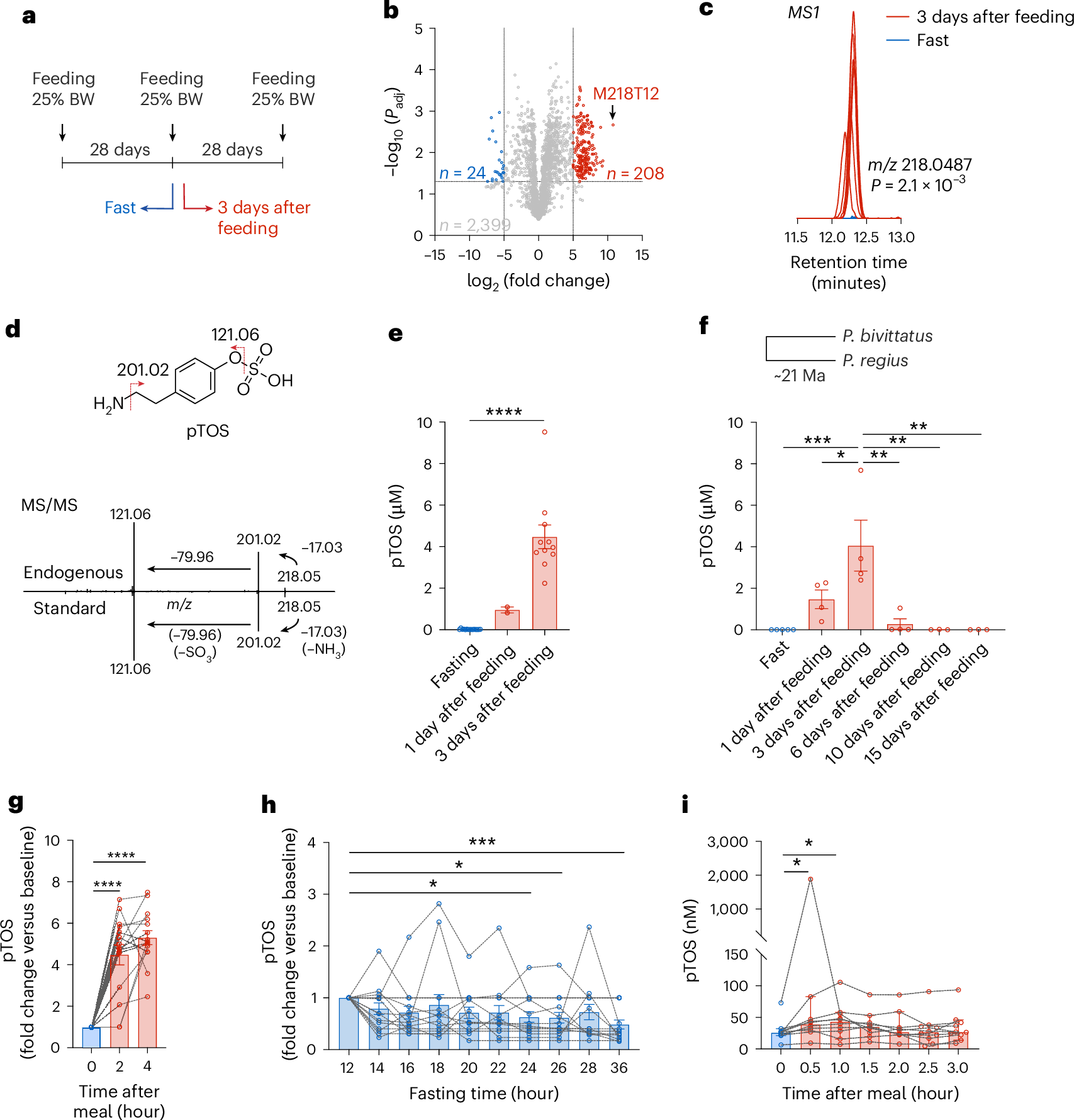
Most mammals consume small and frequent meals. By contrast, pythons are ambush predators that exhibit extreme feeding and fasting patterns and provide a unique model for uncovering molecular mediators of the postprandial response1,2,3. Using untargeted metabolomics, we show that circulating levels of the metabolite para-tyramine-O-sulphate (pTOS) are increased more than 1,000-fold in pythons after a single meal. In pythons, pTOS production occurs in a microbiome-dependent manner via sequential decarboxylation and sulphation of dietary tyrosine. In both pythons and mice, pTOS administration activates a neural population in the ventromedial hypothalamus (VMH). In mice, these VMH neurons are required for the anorexigenic effects of pTOS. Chronic administration of pTOS to diet-induced obese male mice suppresses food intake and body weight. pTOS is also present in human blood, where its levels are increased after a meal. Together, these data uncover a conserved postprandial anorexigenic metabolite that links nutrient intake to energy balance.