2026-03-23 早稲田大学
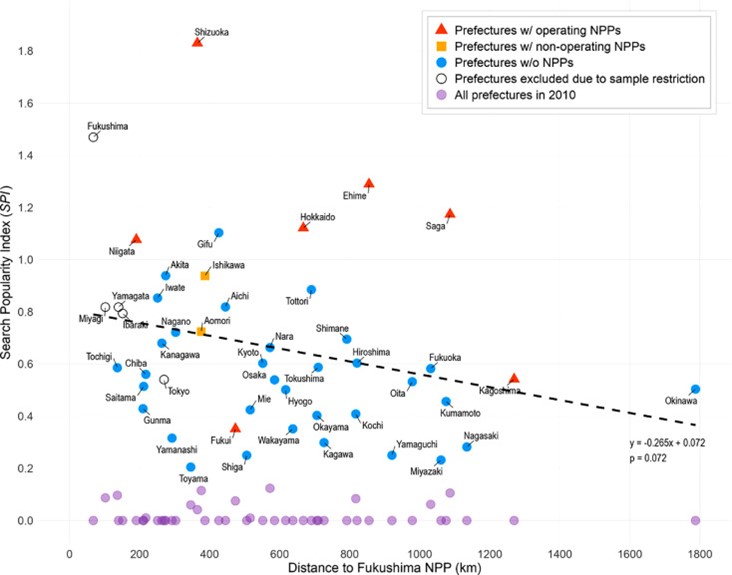
図:福島原子力発電所からの距離と原子力施設の立地状況別にみた放射線不安(論文より)
<関連情報>
- https://www.waseda.jp/inst/research/news/83841
- https://www.sciencedirect.com/science/article/pii/S0167629626000238
目に見えない脅威、目に見える被害:福島原発事故後の放射線不安と出産結果 Invisible threat, tangible harm: Radiation anxiety and birth outcomes after Fukushima
Rong Fu, Yunkyu Sohn, Yichen Shen, Haruko Noguchi
Journal of Health Economics Available online: 7 March 2026
DOI:https://doi.org/10.1016/j.jhealeco.2026.103125
Abstract
Identifying causal effects of prenatal psychological stress on birth outcomes is challenging because stressful events typically bundle psychological stress with material disruptions. The 2011 Fukushima nuclear accident provides a unique setting to overcome this challenge: while physical radiation exposure was geographically limited and well-documented, fear of radiation spread nationwide. We exploit this geographic separation to examine how maternal anxiety independently affects fetal development. Using universal Japanese birth records linked to census data, combined with a novel Google Trends-based measure of radiation-specific anxiety, we employ three complementary identification strategies: population-level comparisons of in-utero exposed versus unexposed cohorts, within-family sibling analysis controlling for time-invariant family characteristics, and dose-response estimation exploiting geographic variation in anxiety intensity. Experiencing the accident during pregnancy increased preterm births by 17% and reduced birth weights by 22–26 grams. Birth outcomes exhibit a clear dose-response relationship with anxiety intensity, with radiation-specific anxiety accounting for 72–79% of the overall preterm birth effects and 28–37% of the overall birth weight effects. Effects are concentrated among socioeconomically disadvantaged mothers and during first-trimester exposure, with the most severe impacts on already-vulnerable infants in the very low and extremely low birth weight categories. Our findings indicate that invisible threats generate measurable intergenerational health impacts through psychological stress pathways, with implications for disaster preparedness and risk communication during contemporary crises from pandemics to climate change.