2026-03-26 京都大学
Designed by Hidetoshi Okutomi
<関連情報>
- https://www.kyoto-u.ac.jp/ja/research-news/2026-03-26-1
- https://www.kyoto-u.ac.jp/sites/default/files/2026-03/web_2603_Umeno-ccc4634795a1d9cbdb0b7a495b9ca1e3.pdf
- https://www.nature.com/articles/s41598-026-43385-z
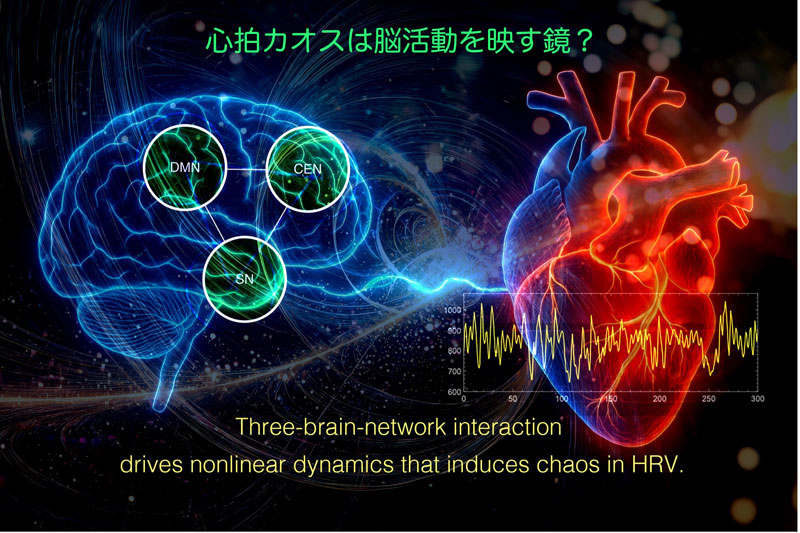
心拍変動のカオスゆらぎが、脳活動を検出する Chaotic fluctuations mark the sign of mental activity in task-based heart rate variability
Tomoyuki Mao,Hidetoshi Okutomi & Ken Umeno
Scientific Reports Published:24 March 2026
DOI:https://doi.org/10.1038/s41598-026-43385-z
Abstract
Heart rate variability (HRV), regulated by the autonomic nervous system, is typically assessed using standard time-domain and frequency-domain methods to evaluate autonomic function. However, conventional linear analyses capture only a limited aspect of HRV, as the human body, including the cardiovascular system, is intrinsically nonlinear. In light of this, there has been growing interest in nonlinear analyses grounded in chaos theory and complexity science. In this study, we conducted a comprehensive comparison of time-domain, frequency-domain, and chaos/complexity indices derived from R-R interval (RRI) analysis during both physical and mental tasks. The results clearly demonstrate a significant increase in chaos/complexity indices during mental tasks, while conventional indices remain unchanged—underscoring the unique sensitivity of nonlinear measures to cognitive processes. These findings highlight the relevance of chaotic dynamics and complexity in HRV as a valuable perspective for understanding brain-heart interactions. Furthermore, based on the experimental findings, we propose a new hypothesis, consistent with previous research, regarding the emergence of chaotic features in HRV during cognitive activity.
.jpg "「巧みな手の動き」の主役は脊髄だった — 随意運動制御における脊髄反射回路の役割を、神経細胞の働きとして実証 —")