2026-04-02 東北大学
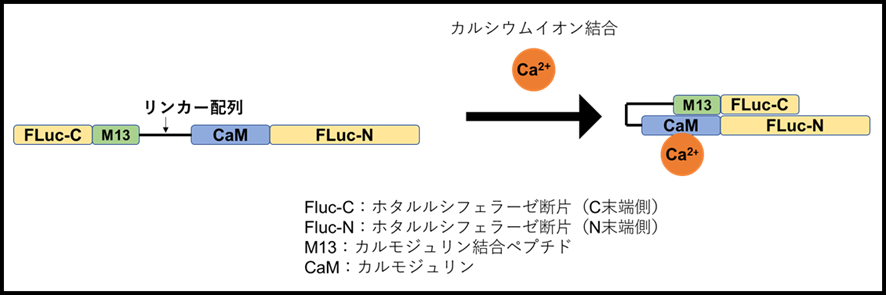
図1. CalLuc-2.1の模式図
]<関連情報>
- https://www.tohoku.ac.jp/japanese/2026/04/press20260402-01-GPCR.html
- https://www.tohoku.ac.jp/japanese/newimg/pressimg/tohokuuniv-press20260402_01web_GPCR.pdf
- https://www.nature.com/articles/s42003-026-09920-4
GPCRを介したカルシウムシグナル伝達の終点測定を可能にする発光性カルシウムバイオセンサー A luminescent calcium biosensor enabling endpoint measurement of GPCR-mediated calcium signaling
Kosuke Doi,Ryoji Kise,Kota Shimizume,Masataka Yanagawa &Asuka Inoue
Communications Biology Published:29 March 2026
DOI:https://doi.org/10.1038/s42003-026-09920-4 Unedited version
Abstract
Gq/11-coupled GPCRs regulate critical physiological processes through calcium mobilization, making intracellular Ca2+ dynamics a key readout for drug discovery and biomarker detection. However, the transient nature of calcium signals necessitates real-time monitoring with specialized equipment, creating barriers for high-throughput screening and limiting accessibility. Here we present CalLuc-2.1, a luminescent calcium biosensor that converts brief Ca2+ spikes into persistent luminescence changes readable tens of minutes after stimulation. By eliminating the need for precisely-timed detection, CalLuc-2.1 enables endpoint measurement of GPCR activation using standard plate readers. We demonstrate robust performance (Z’ > 0.88) across multiple Gq/11-coupled GPCRs in both agonist and antagonist screening formats. Furthermore, CalLuc-2.1 successfully detects endogenous GPCR ligands directly in human serum, offering a simpler alternative to immunoassays and mass spectrometry for biomarker quantification. This approach makes calcium-based GPCR assays accessible to any laboratory with basic luminescence detection capabilities, potentially accelerating both drug discovery and clinical research applications.