2026-04-06 東北大学
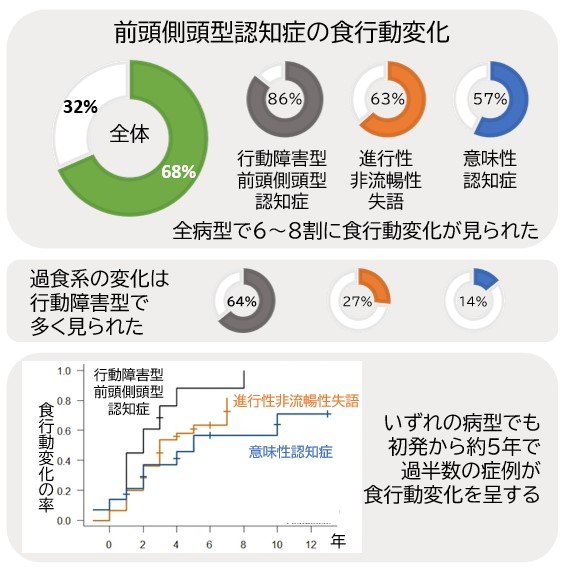
図1. 前頭側頭型認知症の食行動変化
<関連情報>
- https://www.tohoku.ac.jp/japanese/2026/04/press20260406-01-eating.html
- https://www.tohoku.ac.jp/japanese/newimg/pressimg/tohokuuniv-press20260403_01_eating.pdf
- https://bpspsychub.onlinelibrary.wiley.com/doi/10.1111/jnp.70045
前頭側頭型認知症スペクトラムにおける摂食行動プロファイル Eating behaviour profiles across the frontotemporal dementia spectrum
Yuki Sato, Hitomi Hayashi, Kazuo Kakinuma, Chifumi Iseki, Shoko Ota, Kazuto Katsuse, Shiho Matsubara, Nobuko Kawakami, Shigenori Kanno, Keisuke Morihara, …
Journal of Neuropsychology Published: 30 March 2026
DOI:https://doi.org/10.1111/jnp.70045
Abstract
Altered eating behaviours are a hallmark of behavioural variant frontotemporal dementia (bvFTD) but are less well characterised in progressive nonfluent aphasia (PNFA) and semantic dementia (SD). We investigated the frequency and onset of eating behaviour changes across the three subtypes. We retrospectively reviewed the data of 58 patients (14 bvFTD, 30 PNFA and 14 SD). The presence and onset of eating changes were assessed using the Neuropsychiatric Inventory and medical records. Eating behaviours were categorised into overeating, reduced food intake and food preference change. Primary outcomes were prevalence and incidence rates from the initial disease symptoms. A time-to-event analysis was used to compare the cumulative incidence of eating behaviour changes; cumulative incidence curves were estimated using the Kaplan–Meier method; and group differences were assessed using the log-rank test. Although the prevalence of eating changes was the highest in bvFTD (85.7%), followed by PNFA (63.3%) and SD (57.1%), the differences were not statistically significant (p = .220). Incidence also did not differ significantly (p = .054). However, overeating was significantly more frequent in the bvFTD group than in the PNFA and SD groups (p = .011). Changes in appetite and eating behaviour are common across the frontotemporal dementia spectrum and are not limited to bvFTD. Although the overall prevalence is similar across subtypes, overeating is specifically observed in bvFTD, whereas reduced food intake and food preference changes occur non-specifically.