
2026-04-09 産業技術総合研究所
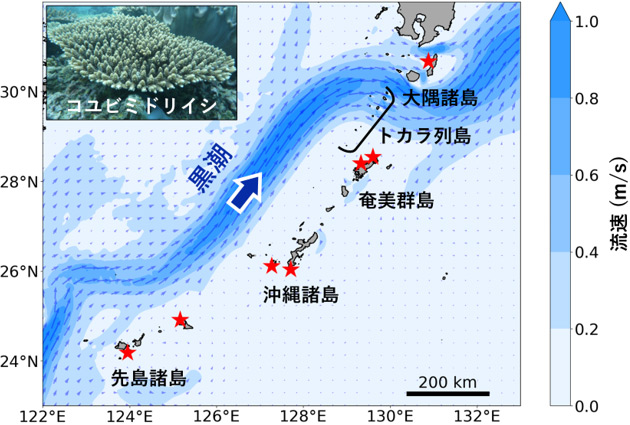
図1 南西諸島の地図と、周辺の海流パターン。赤い星点は、サンゴの一種であるコユビミドリイシ(図左上)のサンプルを集団遺伝解析のために収集した地点を示す。※原論文の図を引用・改変したものを使用しています。
<関連情報>
- https://www.aist.go.jp/aist_j/press_release/pr2026/pr20260409/pr20260409.html
- https://www.nature.com/articles/s41598-026-40448-z
- https://medibio.tiisys.com/110262/
- https://tiisys.com/blog/2025/11/28/post-180746/
黒潮回廊:幼生分散ネットワークが日本のサンゴ生息地間の地理的に独立した連結性を説明する Kuroshio Corridor: larval dispersal networks explain geographically independent connectivity among coral habitats in Japan
Naoki Saito,Hiroki Kise,Yuichi Nakajima & Akira Iguchi
Scientific Reports Published:20 February 2026
DOI:https://doi.org/10.1038/s41598-026-40448-z Unedited version
Abstract
Effective conservation of patchy marine habitats, such as those around islands, requires an understanding of ecological networks maintained through larval dispersal. In the Nansei Islands of Japan, previous studies suggested that the genetic connectivity of reef-building corals was independent of geographic distance along this near-linear island chain, likely due to the Kuroshio Current. However, this has not yet been confirmed using an integrated approach combining population genetics and physical oceanography. Here, we conducted biophysical modelling of larval dispersal and population genomic analysis across the Nansei Islands for a major reef-building coral, Acropora digitifera. Modelled larval dispersal networks showed that dispersal from the southern to northern ends of the archipelago occurred more than six times as frequently as dispersal to the central islands. Genetic connectivity between sites showed a stronger association with modelled dispersal (R = -0.44) than with geographic distance (R = 0.26). Kume Island served as a key stepping stone in the larval dispersal network, despite being outside the area’s national parks. This study provides fundamental insights into the dispersal pathway connecting distant locations along the Kuroshio Current—which we refer to as the ‘Kuroshio Corridor’—a concept that is crucial for connectivity-based conservation.

