2026-07-25 順天堂大学
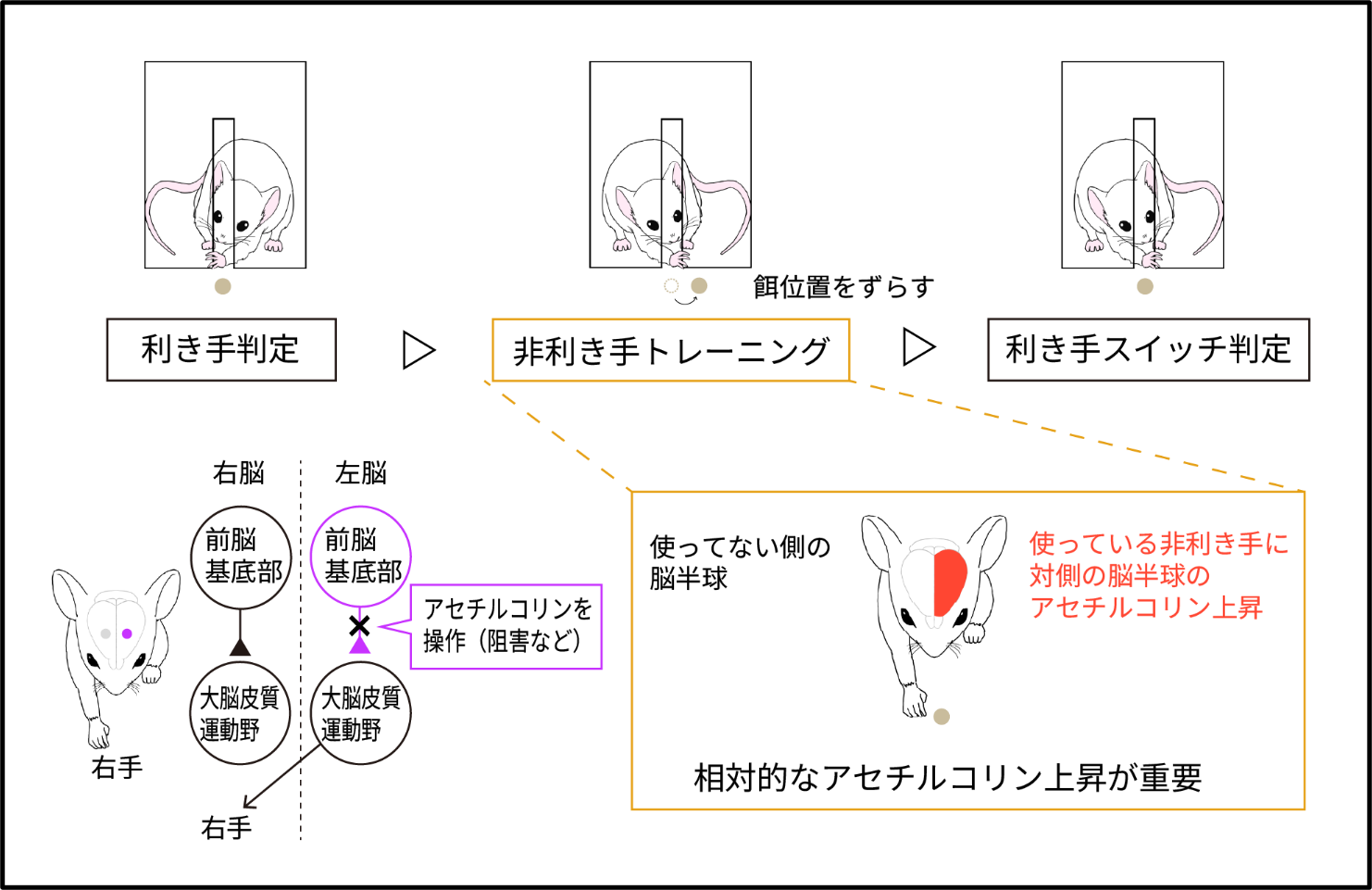
図1:利き手の切り替えには脳半球間のアセチルコリンバランスが重要
<関連情報>
- https://www.juntendo.ac.jp/news/27912.html
- https://www.cell.com/cell-reports/fulltext/S2211-1247(26)00812-0
利き前肢のスイッチを制御する脳半球間のコリン作動性調節 Paw switching with lateralized cholinergic modulation
Kazuki Okamoto ∙ Yasuhiro R. Tanaka ∙ Shigeki Kato ∙ … ∙ Masato Koike ∙ Yulong Li ∙ Hiroyuki Hioki
Cell Reports Published:July 24, 2026
DOI:https://doi.org/10.1016/j.celrep.2026.117734
Highlights
- Mouse paw preference can be switched and maintained after training
- Contralateral cholinergic signaling is required for paw preference switching
- Paw use induces a transient interhemispheric imbalance in cholinergic activity
- Interhemispheric cholinergic balance regulates paw preference switching
Summary
Motor preferences, such as handedness, reflect asymmetries in brain function across vertebrates. Although generally stable, these hand or paw preferences can be reshaped through experience or training; however, the neural basis of such switching remains unclear. Here we show that experience-driven shifts in paw preference in mice arise from asymmetric cholinergic modulation between the two hemispheres. Using a behavioral paradigm designed to induce paw switching, we found that a subset of animals developed a stable change in preference following training. Selective activation or inhibition of cholinergic neurons on one side of the brain was sufficient to bias this switching behavior. During lateralized movements, an endogenous imbalance in cholinergic activity emerges between the hemispheres, suggesting that interhemispheric cholinergic asymmetry enables motor flexibility. These findings identify a previously unrecognized mechanism by which cholinergic signaling dynamically regulates lateralized motor control, providing insight into how hemispheric imbalances may shape persistent individual motor preferences.