2025-06-20 マサチューセッツ工科大学(MIT)
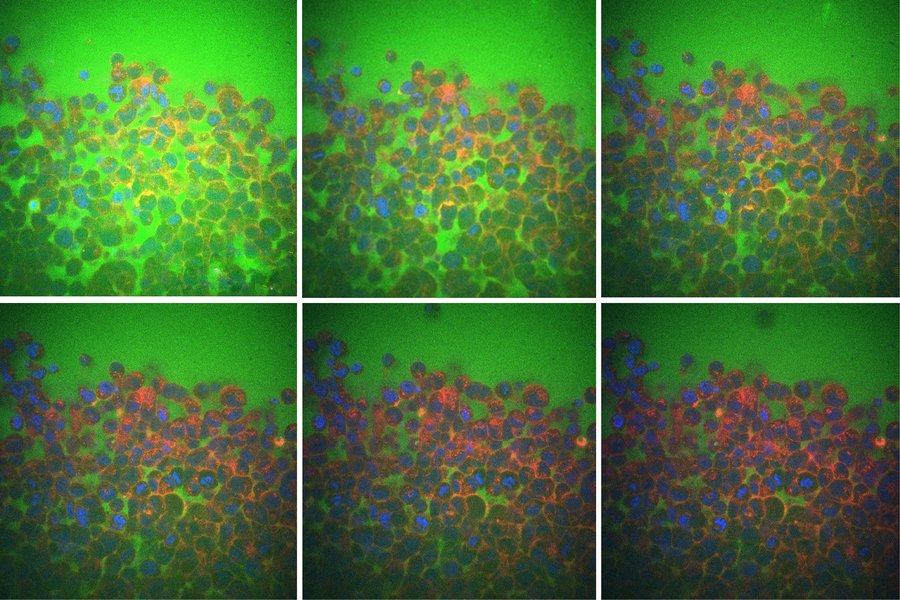
These images directly visualize interstitial fluid (green) between cells (blue with red borders). They also show that the fluid between the cells helps the whole cluster change shape and recover, meaning this fluid movement is important for how tissues respond to pressure or injury. Credits:Image: Courtesy of the researchers
<関連情報>
- https://news.mit.edu/2025/mit-engineers-uncover-surprising-reason-why-tissues-are-flexible-rigid-0620
- https://www.nature.com/articles/s41567-025-02947-0
細胞間流動が多細胞組織の多孔弾性を支配する Intercellular flow dominates the poroelasticity of multicellular tissues
Fan Liu,Bo Gao,Liran Lei,Shuainan Liu,Hui Li & Ming Guo
Nature Physics Published:20 June 2025
DOI:https://doi.org/10.1038/s41567-025-02947-0
Abstract
The mechanical characteristics of cells and extracellular matrices—such as elasticity, surface tension and viscosity—can influence diseases such as fibrosis and tumour metastasis. Multicellular tissues have traditionally been modelled as viscoelastic materials, which overlooked the abundance of intercellular space and intercellular flow within the structure. Although intercellular flow can substantially impact development and disease progression, its role in the mechanical behaviour of tissues remains unclear. Here we show that fluid transport via the intercellular space determines the immediate mechanical response of tissues upon deformation. We directly measure the mechanical response of multicellular tissues by applying parallel plate compression via a tailored micro-mechanics platform. We find that both cultured three-dimensional cell spheroids and native mouse pancreatic islets exhibit apparent poroelastic behaviour over a timescale of up to a minute. These findings highlight the fundamental role of interstitial fluid transport in the mechanics of multicellular systems and could help identify potential physical regulators of development and diseases, as well as strategies for engineering multicellular living systems.