2025-06-26 東京大学,東京科学大学
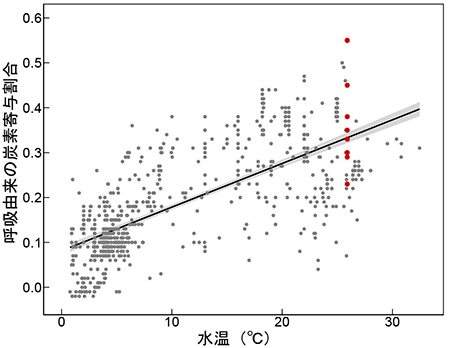
図2:水温と魚類耳石から復元したエネルギー消費量の関係
縦軸は耳石中炭素の呼吸由来の炭素の寄与割合であり、エネルギー消費量の指標である。灰色の点が炭素安定同位体を用いた先行研究、赤い点が本研究で放射性同位体測定した対象魚のデータを表す。放射性炭素を用いて復元した本研究の結果は複数の先行研究から得られた水温との関係と概ね整合的であることがわかる。
<関連情報>
- https://www.aori.u-tokyo.ac.jp/research/news/2025/20250626.html
- https://www.aori.u-tokyo.ac.jp/research/news/2025/files/20250626_summary.pdf
- https://aslopubs.onlinelibrary.wiley.com/doi/10.1002/lol2.70042
新規トレーサーΔ14Cを用いたバンガイカーディナルフィッシュ(Pterapogon kauderni)の耳石の炭素源推定:魚類の代謝と耳石の石灰化に関する新たな示唆Carbon source estimation of Banggai cardinalfish, Pterapogon kauderni, otoliths using a novel tracer Δ14C: New implications for fish metabolism and otolith calcification
Kozue Ando, Kozue Nishida, Yosuke Miyairi, Masahiro Hayashi, Makiko Yorifuji, Toyoho Ishimura, Takahiro Aze, Toshihiro Miyajima, Yusuke Yokoyama
Limnology and Oceanography Letters Published: 25 June 2025
DOI:https://doi.org/10.5281/zenodo.14436929
Abstract
Estimating the metabolic rates of fish is crucial for understanding their physiology and ecology. However, metabolic rate information derived from otolith geochemical data (Moto) has mainly been obtained from mid to high latitudes, leaving a critical information gap for low latitude fishes suffering from climate variability. In this study, we successfully estimated Moto of experimentally reared Banggai cardinalfish (Pterapogon kauderni), a species found exclusively in the Coral Triangle, using a novel method based on radiocarbon (Δ14C) analysis. Moto values for this species were generally consistent with previously reported Moto and temperature data, but were slightly higher, suggesting high metabolism. Furthermore, we found a new species-specific carbon isotope fractionation in otoliths (εtotal), using a combination of radiocarbon and stable carbon isotopes. Our Δ14C results will improve the understanding of the temperature dependence of fish metabolic rates, which is crucial for assessing the species resilience to temperature variability.
Scientific Significance Statement
Estimating the metabolic rate of fish is crucial for understanding their response to environmental change, as it provides key information on their energy requirements. We have, for the first time, successfully estimated a proxy for metabolic rate (Moto) of Pterapogon kauderni using a novel tracer, radiocarbon. This species, which lives in the highly biodiverse Indo-Pacific region, showed high Moto values, indicating its high energy requirements. We also revealed species-specific carbon isotope fractionation of otoliths, which has complicated the interpretation of stable carbon isotope data, using a combination of radiocarbon and stable carbon isotopes. Our findings using radiocarbon will improve the understanding of fish metabolism by providing a more accurate estimate of Moto. This information is crucial for predicting the response of fish growth and survival to climate variability, particularly seawater temperature.