2025-07-01 理化学研究所,久里浜医療センター,静岡県立総合病院,静岡県立大学
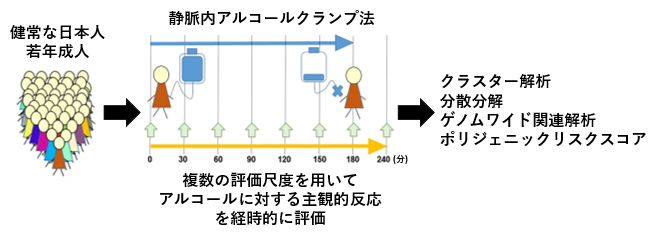
アルコールの反応性に関する解析を行った本研究の全体図
<関連情報>
- https://www.riken.jp/press/2025/20250701_1/index.html
- https://www.nature.com/articles/s41386-025-02147-7
アルコール反応の基礎にある時間依存的な遺伝的要素を解明する Unraveling time-dependent genetic components underlying alcohol response
Keiko Hikino,Ikuo Otsuka,Shunji Oshima,Akitoyo Hishimoto,Kouichi Ozaki,Xiaoxi Liu,Yuki Ishikawa,Taisei Mushiroda,Sachio Matsushita & Chikashi Terao
Neuropsychopharmacology Published:21 June 2025
DOI:https://doi.org/10.1038/s41386-025-02147-7
Abstract
While numerous studies have examined the subjective response to alcohol as an intermediate phenotype to understand its variability, heritability, and predictive capacity for alcohol-related disorders, in-depth analyses linking alcohol reactivity indicators to genetic factors within a large cohort have been absent. Our study aimed to quantify the exact contribution of each genetic variant relevant to the alcohol metabolism to the variability in alcohol response. Specifically, we focused on two primary genes involved in alcohol metabolism (ALDH2 and ADH1B) and three additional loci (ALDH1B1, ALDH1A1, and GCKR) that have been shown to have significant associations with drinking behaviors in Japanese individuals. We conducted the first study to assess the relationship between subjective response to alcohol (SR), evaluated by various assessment subscales, and genetic factors using an intravenous clamp technique in 429 healthy Japanese young adults. By reducing the dimensionality of the data to assess similarity structures, we identified three distinct clusters of SRs and participants. Each participant cluster exhibited a distinct alcohol response profile shaped by specific genetic contributions. Participant cluster 1 demonstrated the strongest response, followed by participant cluster 2, and then participant cluster 3. Participant cluster 1 may also be the most strongly influenced by the allelic status of ALDH2 and ADH1B. SR patterns varied accordingly, and the enrichment of the ALDH2*2 and ADH1B*2, differed across both participant and subscale clusters. Notably, the three participant clusters closely aligned with the three subscale clusters, highlighting a consistent genotype–phenotype relationship. Furthermore, the proportion of variance explained by these genes also varied across subscale clusters. Contrary to known functions, ADH1B showed associations at later timings when ALDH2 associations attenuate. Our three-cluster classification may improve prevention by enabling early identification of individuals at health risk.