2025-09-22 ジョンズ・ホプキンス大学
<関連情報>
- https://hub.jhu.edu/2025/09/22/schizophrenia-bipolar-disorder-brain-organoids/
- https://pubs.aip.org/aip/apb/article/9/3/036118/3364154/Machine-learning-enabled-detection-of
機械学習による統合失調症・双極性障害iPS細胞由来モデルにおける電気生理学的シグネチャの検出
Machine learning-enabled detection of electrophysiological signatures in iPSC-derived models of schizophrenia and bipolar disorder
Kai Cheng;Autumn Williams;Anannya Kshirsagar;Sai Kulkarni;Rakesh Karmacharya;Deok-Ho Kim;Sridevi V. Sarma;Annie Kathuria
APL Bioengineering Published:September 22 2025
DOI:https://doi.org/10.1063/5.0250559
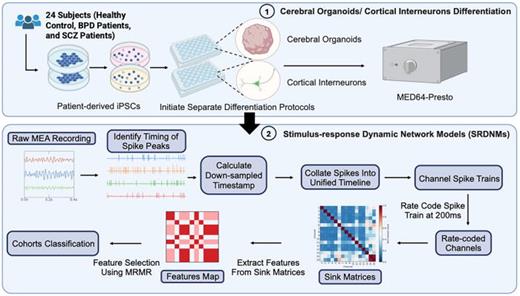
Neuropsychiatric disorders such as schizophrenia (SCZ) and bipolar disorder (BPD) remain challenging to diagnose due to the absence of objective biomarkers, with current assessments relying largely on subjective clinical evaluations. In this study, we present a computational analysis pipeline designed to identify disease-specific electrophysiological signatures from multi-electrode array (MEA) recordings of patient-derived cerebral organoids (COs) and two-dimensional cortical interneuron cultures (2DNs). Using a Support Vector Machine classifier optimized for high-dimensional data, we achieved 95.8% classification accuracy in distinguishing SCZ from control samples in 2DNs under both baseline and post-electrical-stimulation (PES) conditions with the extracted electrophysiological signatures. In COs, classification accuracy improved from 83.3% at baseline to 91.6% following PES, enabling robust separation of control, SCZ, and BPD cohorts. Key discriminative features included channel-specific measures of network activity, with PES significantly enhancing classification performance, particularly for BPD. These results underscore the potential of MEA-based functional phenotyping, coupled with machine learning, to uncover reliable, stimulation-sensitive electrophysiological biomarkers, offering a path toward more objective diagnosis and personalized treatment strategies for neuropsychiatric disorders.