
2025-07-03 ロックフェラー大学
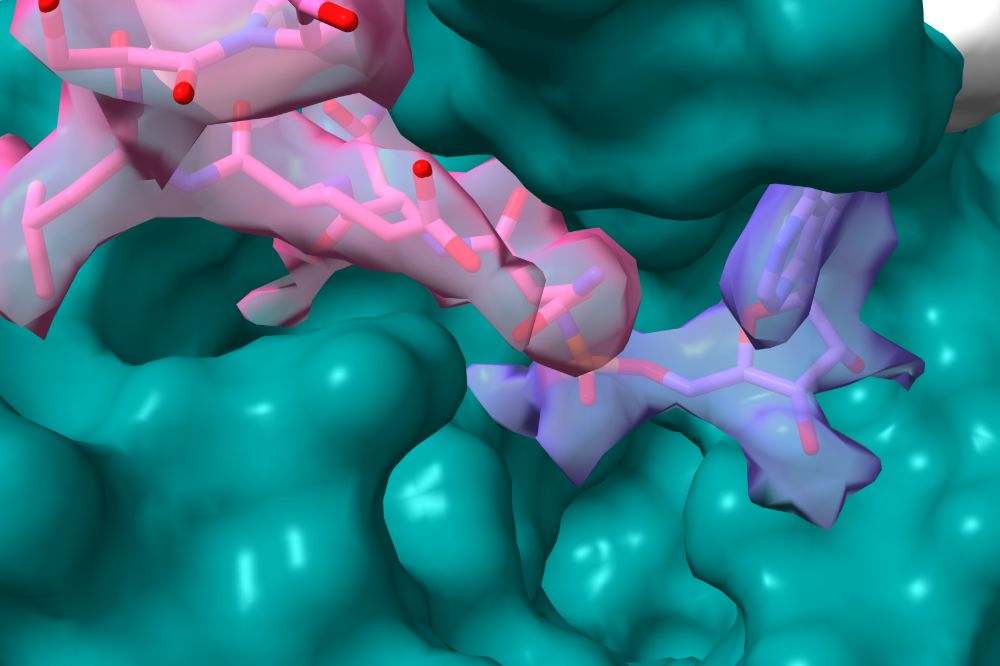 Detail from Small’s reprocessed cryo-EM data zooming in on an unoccupied area of the SARS-CoV-2 NiRAN domain. (Courtesy of Campbell lab)
<関連情報>
- https://www.rockefeller.edu/news/37986-rockefeller-team-finds-flawed-data-in-recent-study-relevant-to-coronavirus-antiviral-development/
- https://www.cell.com/cell/abstract/S0092-8674(25)00632-4
SARS-CoV-2のNiRANドメインによるGTPを介したRNAキャッピングのメカニズムは未解明のままである The mechanism for GTP-mediated RNA capping by the SARS-CoV-2 NiRAN domain remains unresolved
Gabriel I. Small ∙ Seth A. Darst ∙ Elizabeth A. Campbell
Cell Published:June 25, 2025
DOI:https://doi.org/10.1016/j.cell.2025.05.044
Highlights
- Analysis of PDB: 8GWE reveals errors in the construction of the atomic model
- The associated cryo-EM data do not support the modeling of critical active site features
- Reprocessing confirms there is no GMPPNP in the putative E-RTC:RNA-nsp9:GMPPNP complex
Summary
The Nidovirus RdRp-associated nucleotidyltransferase (NiRAN) domain initiates mRNA capping in coronaviruses through a GDP-polyribonucleotidyltransferase reaction, with RNA covalently linked to nsp9. GDP is the preferred substrate for this reaction, but the NiRAN domain can also utilize GTP to produce an authentic 5′ RNA cap structure, though the GTP-mediated mechanism is unclear. Yan and colleagues claimed to have delineated the reaction mechanism from the analysis of a cryoelectron microscopy (cryo-EM) structure of a trapped catalytic intermediate of the SARS-CoV-2 NiRAN domain with a β-γ-non-hydrolyzable GTP analog (GMPPNP) and RNA-nsp9 (PDB: 8GWE). We show that the cryo-EM data used to derive PDB: 8GWE do not support the presence of GMPPNP in the NiRAN active site, and the resulting atomic model is incompatible with fundamental chemical principles. We conclude that Yan and colleagues’ conclusions are not experimentally supported and the mechanism for GTP-mediated RNA capping by the SARS-CoV-2 NiRAN domain remains unresolved. This Matters Arising paper is in response to Yan et al. (2022), published in Cell. See also the response by Huang et al. (2025), published in this issue.

