2025-07-04 東京大学,科学技術振興機構
他者についての記憶を整理する脳の仕組み
<関連情報>
- https://www.iqb.u-tokyo.ac.jp/pressrelease/250704/
- https://www.science.org/doi/10.1126/science.adp3814
腹側CA1ニューロンにおける性特異的社会記憶の表現 Representation of sex-specific social memory in ventral CA1 neurons
Akiyuki Watarai, Kentaro Tao, and Teruhiro Okuyama
Science Published:3 Jul 2025
DOI:https://doi.org/10.1126/science.adp3814
Editor’s summary
Social memory is crucial for humans and other social animals. It is known that specific neural populations in the hippocampal ventral CA1 region store and represent specific social memories. However, it remains unclear how these neural populations represent identities and properties of social memory such as sex and strain. Watarai et al. discovered two distinct types of social memory neurons in CA1: cells responding to the identity of an individual and those responding to either the specific sex or specific strain of this individual. Selective reactivation of female sex cells, but not male sex cells, was sufficient to induce a reinforcement effect, suggesting a distinct population that represents sex-specific information. These findings reveal both the physiological and functional mechanisms of sex-specific representations in social memory. —Peter Stern
Structured Abstract
INTRODUCTION
The ability to recognize familiar individuals is fundamental to social behavior in animals because it enables them to navigate complex social environments. In mammals, social memory involves not only recognition of individuals, but also of a range of social attributes including genetic and physical traits such as sex. Prior studies have shown that different parts of the hippocampus are involved in storing and processing social information, but how individual neurons combine multiple social features into cohesive memories is not fully understood. In particular, the role of hippocampal circuits in encoding sex-specific features of familiar conspecifics remains unclear.
RATIONALE
We hypothesized that the activities of ventral CA1 (vCA1) neurons in the hippocampus reflect the rich, multidimensional nature of social information about familiar individuals. This information, including their sex and genetic background, may be encoded by distinct neural populations, activity patterns, or both. To test this, we recorded vCA1 neuronal activity in male mice as they interacted with familiar individuals that differed in sex and strain. We then assessed whether reactivating these memories would modulate behavior depending on the sex of the familiar individual.
RESULTS
We found that vCA1 neurons encoded both the individual identity and general properties of familiar individuals. Some neurons responded selectively to a specific sex or strain (“social property cells”), whereas others responded to nonlinear combinations of sex and strain (“social identity cells”). These neurons encoded social information through both changes in firing rate and precise spike timings relative to the hippocampal theta rhythm.Additionally, activity-dependent genetic labeling and optogenetic reactivation of female-associated, but not male-associated, social memories induced place preference in mice. Activation of overlapping populations of neurons representing two distinct female-associated social memories recapitulated this positive reinforcing effect. Furthermore, ablating two brain regions upstream of vCA1, the dorsal CA2 (dCA2) and the medial amygdala (MeA), disrupted the population coding of sex embedded within social memory.
CONCLUSION
Our findings demonstrate that the vCA1 neurons encode social memories across multiple representational dimensions, using distinct neuron populations to represent individual identity and social properties such as sex. These neurons use both rate and temporal coding schemes, with social property cells organizing a generalized map of social information that is temporally compressed within hippocampal theta cycles. We further discovered that these social memories convey sexually dichotomous emotional valence emerging from population coding of sex shaped by inputs from upstream dCA2 and MeA. Our study thus illustrates a neural mechanism by which the brain coordinates diverse social attributes to form unified memory representations, offering a perspective on how social information is integrated into hierarchical episodic memory systems.
OPEN IN VIEWER
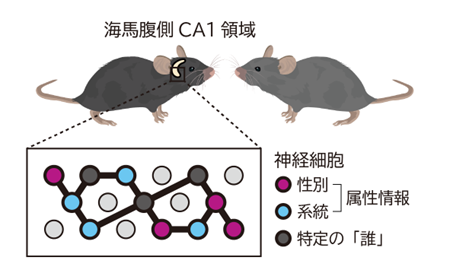
Multifaceted social memory coding by ventral hippocampal neurons.
vCA1 neurons in the hippocampus encode the identity and social properties (sex and strain) of familiar individuals, with activity temporally coordinated by hippocampal theta rhythms. Social memory engrams carry sexually dichotomous emotional valence through population coding of sex shaped by inputs from upstream dCA2 and the MeA. [Mouse illustrations: Hiromasa Ono (© 2016 DBCLS TogoTV, CC-BY-4.0)]
Abstract
Recognizing familiar individuals is crucial for adaptive social interactions among animals. However, the multidimensional nature of social memory encompassing sexual information remains unelucidated. We found that neurons in the ventral CA1 region (vCA1) of the mouse hippocampus encoded the identities and social properties, specifically sex and strain, of familiar conspecifics by using both rate and theta-based temporal coding. Optogenetic reactivation of social memories of females, but not males, induced place preference. Ablation of the upstream hippocampal dorsal CA2 region or the medial amygdala disrupted the representation of sex and the sexual dichotomy of social memory valence. Thus, vCA1 neurons use dual coding schemes to represent the identities and social properties of familiar conspecifics as a cohesive memory.