
2025-07-01 ラトガース大学
<関連情報>
- https://www.rutgers.edu/news/herbal-mouthwash-targets-gum-germs-while-letting-helpful-bacteria-flourish
- https://www.frontiersin.org/journals/oral-health/articles/10.3389/froh.2025.1529061/full
多種の口腔バイオフィルムに対する選択的抗菌効果を有する自然療法マウスウォッシュを活用し、ディスバイオシスの予防を図る
Utilizing a naturopathic mouthwash with selective antimicrobial effects against multispecies oral biofilms for prevention of dysbiosis
Danyal A. Siddiqui,Yi-Wen C. Tsai,Juliana Giron Bastidas,Marzieh S. Jazaeri,Georgios A. Kotsakis
Frontiers in Oral Health Published:19 May 2025
DOI:https://doi.org/10.3389/froh.2025.1529061
Introduction: Oral rinses intended for the prevention and treatment of periodontal diseases have traditionally focused on bactericidal effects. This study evaluates the efficacy of a naturopathic mouthwash containing plant attenuations and propolis against common gram- pathogenic and gram+ commensal oral species in comparison to conventional antiseptic oral rinses.
Methods: Streptoccoccus oralis, Streptococcus gordonii, Veillonella parvula, Fusobacterium nucleatum, and Porphyromonas gingivalis were cultured and treated with naturopathic StellaLife® VEGA® Oral Rinse (SL), 0.12% chlorhexidine gluconate (CHX), LISTERINE® COOL MINT® mouthwash (LIS), or phosphate-buffered saline (PBS) as negative control. Firstly, planktonic bacterial growth was assessed through optical density measurements and colony-forming unit (CFU) counts. Subsequently, a 4-species or clinical ex vivo multispecies biofilm was used to evaluate antibiofilm effects through selective agar plating and fluorescence in situ hybridization (FISH) or live-dead biofilm imaging, respectively. Lastly, cytocompatibility to oral rinses was tested using a 3D human fibroblast spheroid model.
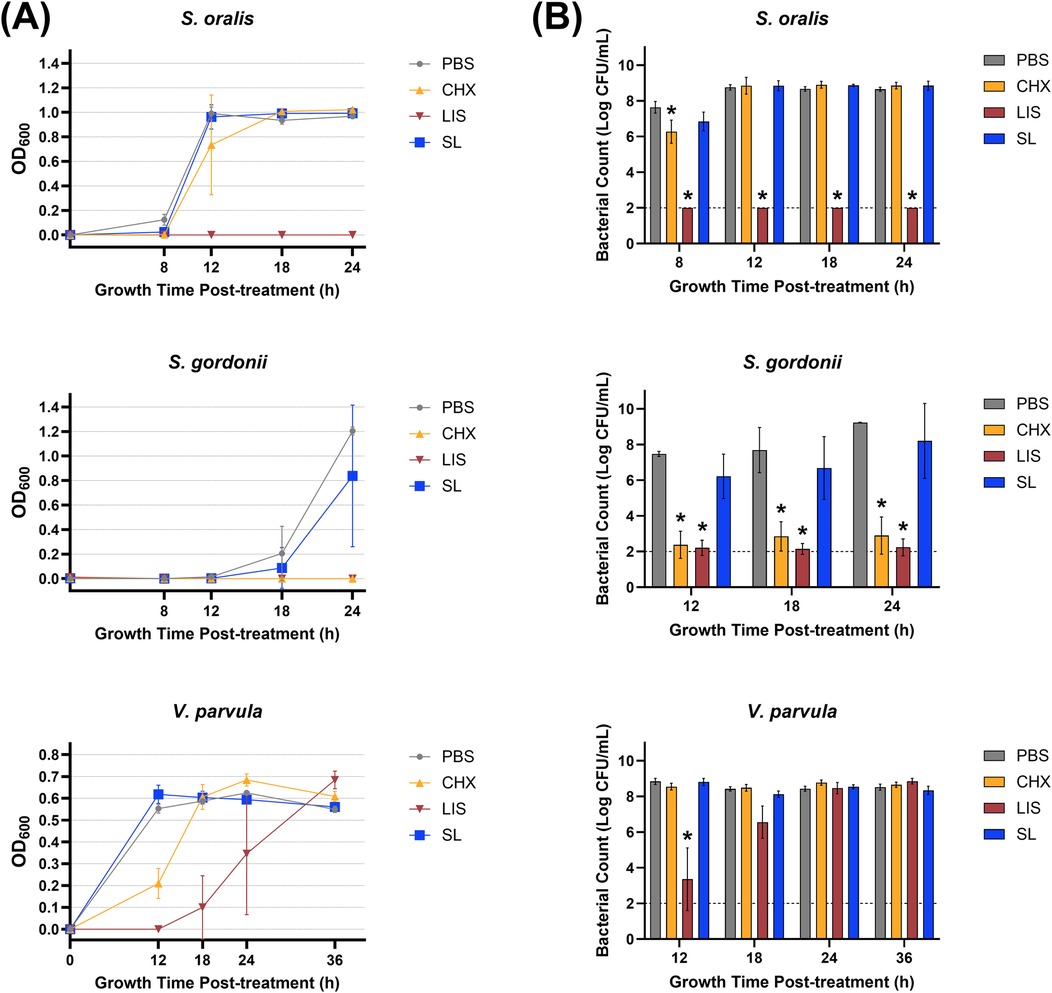
Results: SL significantly inhibited the growth of disease-associated F. nucleatum and P. gingivalis 12 and 120 h, respectively, after treatment, while exhibiting lower toxicity toward commensal S. oralis, S. gordonii, and V. parvula vs. LIS or CHX (all p < 0.05). Correspondingly, in 4-species biofilms, selective agar plating and FISH-staining showed decreased abundance of F. nucleatum and P. gingivalis after 4 h recovery following SL treatment vs. PBS control while maintaining a robust commensal biofilm of S. oralis and V. parvula. In contrast, CHX or LIS treatment demonstrated non-selective killing, leading to sparse biofilms with residual F. nucleatum and P. gingivalis. When tested against clinical ex vivo multispecies biofilms, all oral rinses showed significant antibiofilm effects (all p < 0.001), disrupting biofilm structure and reducing bacterial viability. Lastly, 3D human fibroblast spheroids treated with CHX or LIS displayed greater cytotoxicity with detachment of cellular debris from the spheroid mass, while spheroids exposed to SL exhibited minimal cell death with cellular viability maintained across the spheroid structure.
Discussion: The SL homeopathic rinse demonstrated selective action on oral bacteria, preferentially reducing pathogen bacterial load while preserving commensal species with high cytocompatibility. Future validation in human studies is needed to assess its selective antimicrobial activity to maintain a eubiotic oral microbiome and explore broader applications in oral health.

