2025-08-13 ワシントン州立大学(WSU)
<関連情報>
- https://news.wsu.edu/press-release/2025/08/13/wsu-team-unlocks-biological-process-behind-coho-die-offs/
- https://pubs.acs.org/doi/10.1021/acs.est.5c01559
道路排水と6PPD-キノンの暴露を受けたコホサケにおける血液-脳バリアと血液-鰓バリアの破壊 Blood–Brain and Blood–Gill Barrier Disruption in Coho Salmon Exposed to Roadway Runoff and 6PPD-Quinone
Stephanie I. Blair,Jill Wetzel,Melissa Gonzalez,Edward P. Kolodziej,Chelsea J. Mitchell,Garrett M. Foster,Valerie Lynch-Holm,and Jenifer K. McIntyre
Environmental Science & Technology Published June 17, 2025
DOI:https://doi.org/10.1021/acs.est.5c01559
Abstract
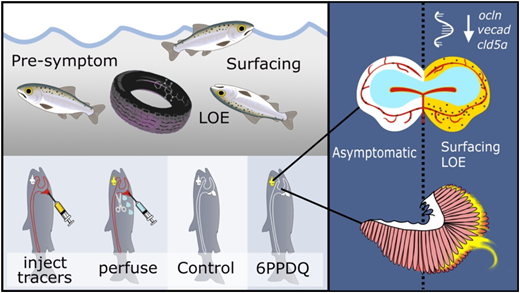
The tire-derived chemical N-(1,3-dimethylbutyl)-N′-phenyl-p-phenylenediamine-quinone (6PPD-quinone) causes acute mortality in coho salmon (Oncorhynchus kisutch), yet its mechanisms of toxicity remain poorly understood. We exposed juvenile coho salmon to roadway runoff or 6PPD-quinone to investigate whether disruption of the blood–brain barrier (BBB) and blood–gill barrier cause behavioral symptoms of urban runoff mortality syndrome in this sensitive species. BBB disruption was present in one-third of presymptomatic fish and in all symptomatic individuals, supporting its role in toxicity. Co-occurring brain and gill barrier disruptions at the onset of sustained surface swimming suggest a systemic vascular response rather than localized brain injury. Histological analysis of coho brains revealed red blood cell congestion within intact endothelia, consistent with circulatory collapse and plasma leakage, likely impairing oxygen delivery and disrupting neuronal signaling. Behavioral symptoms also coincided with altered expression of BBB junctional proteins genes (ocln, cld5α, and vecad). In Chinook salmon (Oncorhynchus tshawytscha), exposure to a high but environmentally relevant concentration of 6PPD-quinone reduced expression of the scaffolding protein zo-1, suggesting potential sublethal effects. These findings identify BBB disruption as a key event in 6PPD-quinone toxicity and link vascular injury to behavioral symptoms in coho salmon. Ongoing work in this model will further clarify mechanisms of action and support assessments of environmental and human health risks from tire-derived chemicals.