2025-08-22 英国研究イノベーション機構(UKRI)
<関連情報>
- https://www.ukri.org/news/new-study-finds-hidden-body-fat-is-linked-to-faster-heart-ageing/
- https://academic.oup.com/eurheartj/advance-article/doi/10.1093/eurheartj/ehaf553/8237967
性差による体脂肪分布は心血管老化を予測する Sex-specific body fat distribution predicts cardiovascular ageing
Vladimir Losev , Chang Lu , Shamin Tahasildar , Deva S Senevirathne , Paolo Inglese , Wenjia Bai , Andrew P King , Mit Shah , Antonio de Marvao , Declan P O’Regan
European Heart Journal Published:22 August 2025
DOI:https://doi.org/10.1093/eurheartj/ehaf553
Abstract
Background and Aims
Cardiovascular ageing is a progressive loss of physiological reserve, modified by environmental and genetic risk factors, that contributes to multi-morbidity due to accumulated damage across diverse cell types, tissues, and organs. Obesity is implicated in premature ageing, but the effect of body fat distribution in humans is unknown. This study determined the influence of sex-dependent fat phenotypes on human cardiovascular ageing.
Methods
Data from 21 241 participants in the UK Biobank were analysed. Machine learning was used to predict cardiovascular age from 126 image-derived traits of vascular function, cardiac motion, and myocardial fibrosis. An age-delta was calculated as the difference between predicted age and chronological age. The volume and distribution of body fat was assessed from whole-body imaging. The association between fat phenotypes and cardiovascular age-delta was assessed using multivariable linear regression with age and sex as co-covariates, reporting β coefficients with 95% confidence intervals (CI). Two-sample Mendelian randomization was used to assess causal associations.
Results
Visceral adipose tissue volume [β = 0.656, (95% CI, .537–.775), P < .0001], muscle adipose tissue infiltration [β = 0.183, (95% CI, .122–.244), P = .0003], and liver fat fraction [β = 1.066, (95% CI .835–1.298), P < .0001] were the strongest predictors of increased cardiovascular age-delta for both sexes. Abdominal subcutaneous adipose tissue volume [β = 0.432, (95% CI, .269–.596), P < .0001] and android fat mass [β = 0.983, (95% CI, .64–1.326), P < .0001] were each associated with increased age-delta only in males. Genetically predicted gynoid fat showed an association with decreased age-delta.
Conclusions
Shared and sex-specific patterns of body fat are associated with both protective and harmful changes in cardiovascular ageing, highlighting adipose tissue distribution and function as a key target for interventions to extend healthy lifespan.
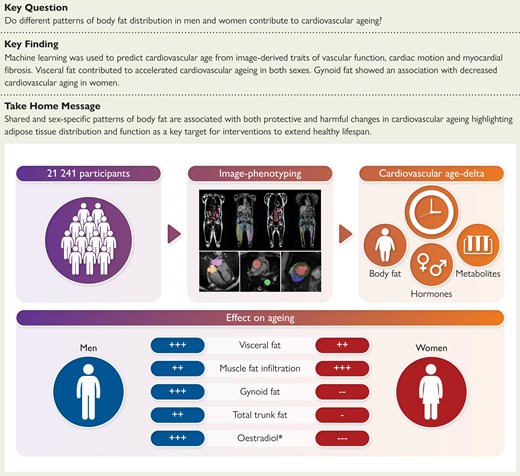
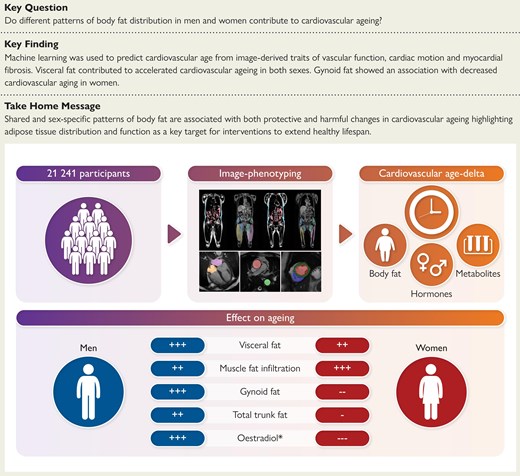
Structured Graphical AbstractThe association of body fat phenotypes and cardiovascular ageing was assessed in 21 241 participants. This showed how shared and sex-specific patterns of body fat are associated with protective and harmful changes in cardiovascular ageing. *Protective effects of oestradiol in pre-menopausal women.