2025-08-27 北海道大学
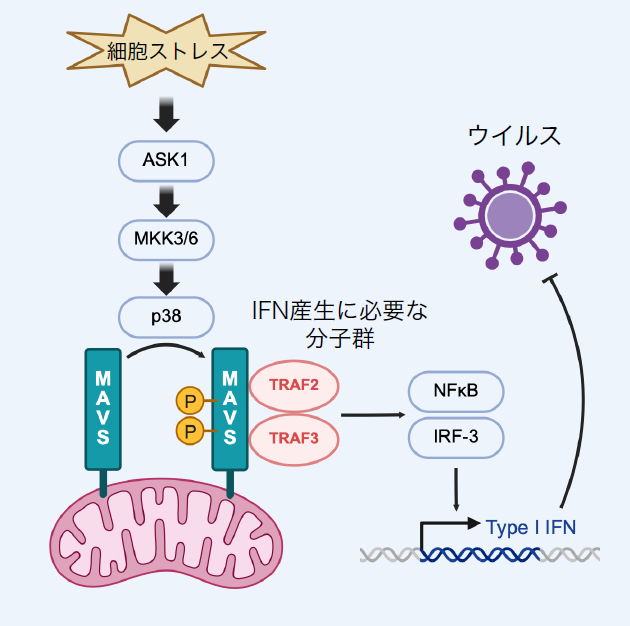
細胞ストレスは、ASK1-p38 MAPK経路でMAVSのリン酸化を誘導する。MAVSのリン酸化はIFN産生を選択的に増強させ、ウイルスの封じ込めに貢献する。
<関連情報>
- https://www.hokudai.ac.jp/news/2025/08/post-2043.html
- https://www.hokudai.ac.jp/news/pdf/250827_pr3.pdf
- https://www.cell.com/iscience/fulltext/S2589-0042(25)01517-2
MAVSのリン酸化が抗ウイルス免疫を調節するストレスセンサーとして機能する MAVS phosphorylation acts as a cellular stress sensor that modulates antiviral immunity
Dongyi Zhao ∙ Nao Morimoto, ∙ Riho Saito ∙ … ∙ Hidetaka Kosako ∙ Yukiko Gotoh ∙ Tomohiko Okazaki
iScience Published:July 31, 2025
DOI:https://doi.org/10.1016/j.isci.2025.113256
Highlights
- MAVS is phosphorylated by stress-responsive ASK1–p38 MAPK signaling
- MAVS phosphorylation enhances type I IFN induction via recruitment of key downstream adaptors
- Phosphorylation selectively amplifies IFN expression but not apoptosis upon viral infection
- Cellular stress enhances MAVS signaling via phosphorylation to fine-tune antiviral immunity
Summary
Upon viral infection, cytosolic RIG-I-like receptors recognize viral RNA and activate innate immune responses through the mitochondrial antiviral-signaling protein (MAVS), leading to type I interferon (IFN) production and apoptosis. Cellular stress influences immune activation, but its impact on MAVS signaling remains largely unclear. Here, we show that MAVS undergoes phosphorylation via p38 MAPK signaling, activated by the stress-activated MAPKKK ASK1. This modification enhances MAVS interaction with TRAF, a key downstream adaptor, thereby promoting type I IFN induction. Oxidative and endoplasmic reticulum stress significantly amplified type I IFN expression upon viral infection, but this effect was attenuated in cells expressing MAVS mutants lacking phosphorylation sites. These findings suggest MAVS phosphorylation as a key mechanism integrating cellular stress signals into antiviral immunity. By linking the MAPK pathway to MAVS-dependent IFN expression, we propose MAVS phosphorylation as a cellular stress sensor that modulates antiviral immunity in a context-dependent manner.