2025-09-04 金沢大学ナノ生命科学研究所
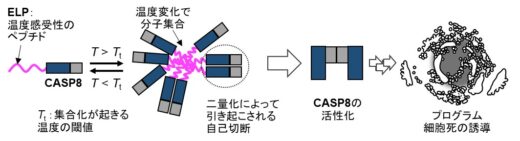
図1 ある一定温度の閾値(Tt )で起きる分子集合を活用して、カスパーゼ8(CASP8)を活性化(サーマルジェネティクス)。*細胞の図は、NIAID NIH BioArtより引用(掲載論文の図を許可を得て改変)。
<関連情報>
プログラム細胞死制御のためのエラスチン様ポリペプチドを用いた熱発生ツール A Thermogenetic Tool Employing Elastin-like Polypeptides for Controlling Programmed Cell Death
Cong Quang Vu,and Satoshi Arai
ACS Nano Published: September 3, 2025
DOI:https://doi.org/10.1021/acsnano.5c07332
Abstract
Thermogenetics uses temperature-sensitive proteins to regulate cellular functions via temperature changes. Compared to optogenetics, which utilizes visible light and is limited by light penetration, thermogenetics offers a practical alternative by enabling deeper and more accessible control of cellular processes via heat. Herein, we report the development of a thermogenetically controlled programmed cell death system that enables heat-activated human caspase 8 (CASP8) using temperature-responsive elastin-like polypeptides (ELPs). The core functionality of this system relies on the reversible phase transition behavior of ELPs, which transition from a soluble state to a coacervate state in response to thermal stimuli. By exploiting this temperature-dependent behavior, we fused ELP[V60] with the catalytic domain of CASP8 to construct the ELP[V60]-CASP8 fusion. Upon heating at temperatures above 35 °C, the ELP[V60] in the fusion protein underwent coacervation, increasing the local concentration of CASP8 to facilitate dimerization-induced activation and promote cell death in HEK293T cells. We observed a correlation between the heating temperature and the duration required to induce cytotoxicity at higher temperatures, requiring shorter heating times. Additionally, we developed a CASP8 indicator to monitor CASP8 activation and demonstrated its functionality in HEK293T cells. We further used optical heating with a 1470 nm laser combined with fluorescence lifetime-based thermometry to achieve localized activation of CASP8 in target single cells with precise and controlled temperature increments.