2025-09-04 ワシントン大学セントルイス校
<関連情報>
- https://source.washu.edu/2025/09/mouse-study-links-chronic-pain-to-disrupted-sleep-patterns/
- https://www.nature.com/articles/s41386-025-02152-w
マウスの炎症性疼痛は、睡眠構造に光周期依存性の影響を誘発する Inflammatory pain in mice induces light cycle-dependent effects on sleep architecture
Dominika J. Burek,Khairunisa Mohamad Ibrahim,Andrew G. Hall,Ashish Sharma,Jessica A. Cucinello-Ragland,Erik S. Musiek,Jose A. Morón &William A. Carlezon Jr.
Neuropsychopharmacology Published:22 June 2025
DOI:https://doi.org/10.1038/s41386-025-02152-w
Abstract
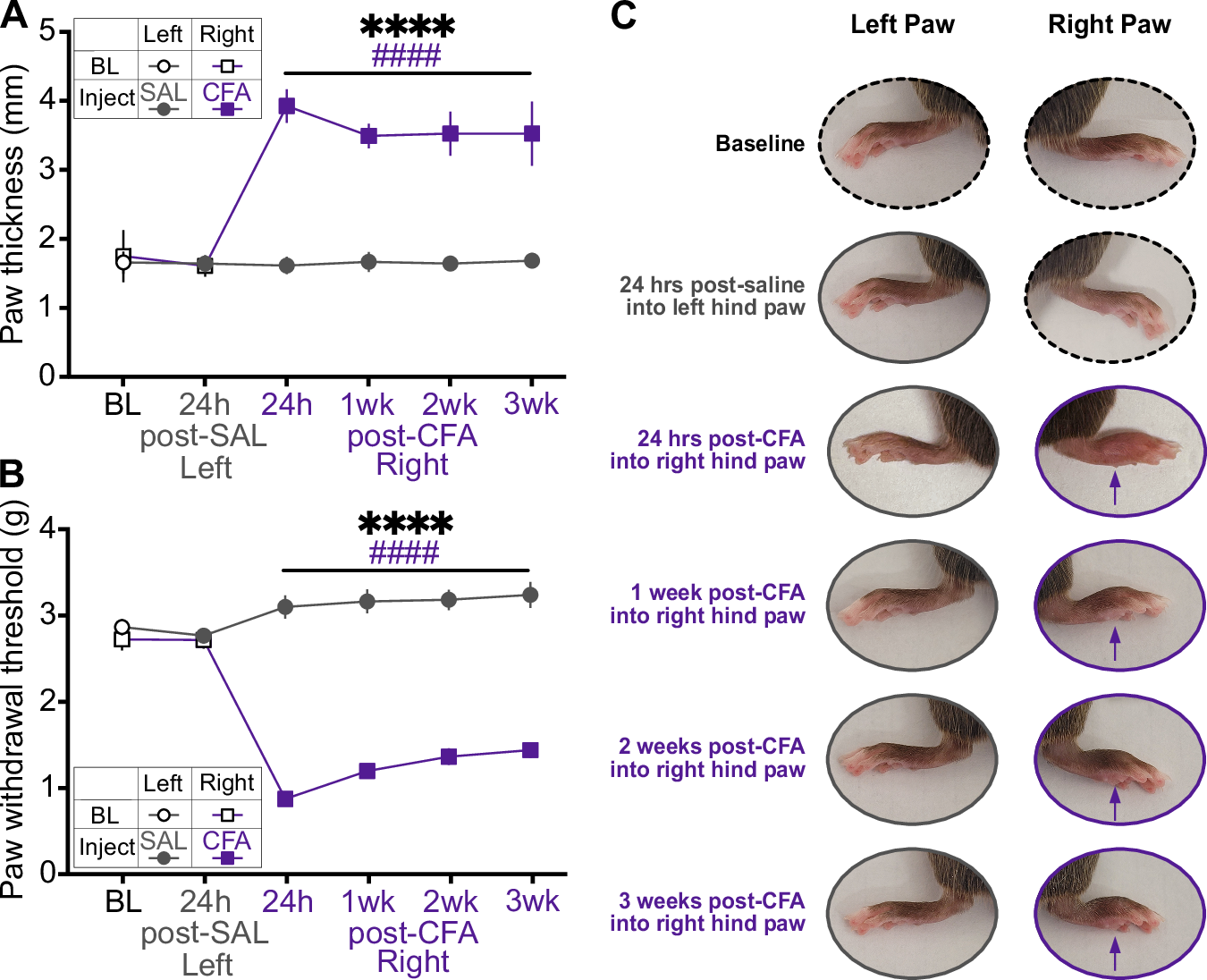
Pain syndromes include physical, sensory, emotional, and cognitive symptoms such as disability, negative affect, feelings of stress, and fatigue. Experimental induction of long-term inflammatory pain in rodents by hindpaw injection of complete Freund’s adjuvant (CFA) produces anhedonia and dysregulated naturalistic behaviors, similar to the effects of unregulated stress. We examined whether these similarities extend to changes in sleep and rhythms, such as those induced by chronic social defeat stress, using actigraphy and wireless EEG in mice. Comparisons were made between groups that received injections at the onset of the light or dark phase. We found that CFA-induced inflammatory pain alters sleep architecture in both sexes; most notably, it increased sleep duration in the dark phase—when mice are normally more likely to be awake—while also increasing sleep bout length and reducing wake bout length. In contrast, during the light phase, it decreased sleep bout length, indicating fragmentation. Similarly, CFA-induced increases in REM and SWS duration and bouts were largest during the dark phase. Dark-phase effects were remarkably consistent regardless of whether the mice had been injected at darkness onset or 12 h earlier, whereas light-phase effects were more dependent on time since injection. Injections also produced non-specific alterations in circadian rhythmicity. Our findings indicate that inflammatory pain prominently increases sleep during normally active phases as well as transitions between sleep and wakefulness throughout the day. These effects align with clinical observations and establish a basis for mechanistic studies and use of these procedures to better predict outcomes in humans.