2025-09-12 マサチューセッツ工科大学
<関連情報>
- https://news.mit.edu/2025/mit-spinout-cache-dna-takes-biomolecule-storage-out-freezer-0912
- https://pubs.acs.org/doi/10.1021/jacs.4c01925
分解可能なガラス状高分子ネットワークにおける可逆的核酸貯蔵 Reversible Nucleic Acid Storage in Deconstructable Glassy Polymer Networks
Elisabeth Prince,Ho Fung Cheng,James L. Banal,Jeremiah A. Johnson
Journal of the American Chemical Society Published: June 12, 2024
DOI:https://doi.org/10.1021/jacs.4c01925
Abstract
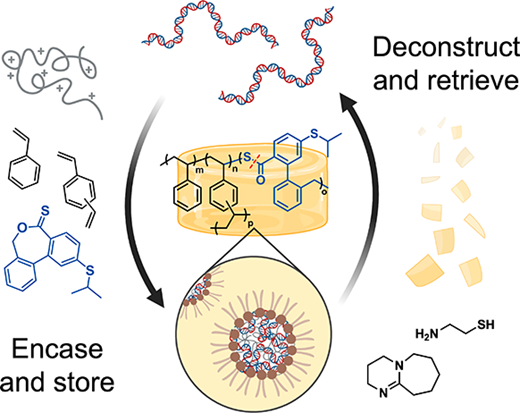
The rapid decline in DNA sequencing costs has fueled the demand for nucleic acid collection to unravel genomic information, develop treatments for genetic diseases, and track emerging biological threats. Current approaches to maintaining these nucleic acid collections hinge on continuous electricity for maintaining low-temperature and intricate cold-chain logistics. Inspired by the millennia-long preservation of fossilized biological specimens in calcified minerals or glassy amber, we present Thermoset-REinforced Xeropreservation (T-REX): a method for storing DNA in deconstructable glassy polymer networks. Key to T-REX is the development of polyplexes for nucleic acid encapsulation, streamlining the transfer of DNA from aqueous to organic phases, replete with initiators, monomers, cross-linkers, and thionolactone-based cleavable comonomers required to form the polymer networks. This process successfully encapsulates DNA that spans different length scales, from tens of bases to gigabases, in a matter of hours compared to days with traditional silica-based encapsulation. Further, T-REX permits the extraction of DNA using comparatively benign reagents, unlike the hazardous hydrofluoric acid required for recovery from silica. T-REX provides a path toward low-cost, time-efficient, and long-term nucleic acid preservation for synthetic biology, genomics, and digital information storage, potentially overcoming traditional low-temperature storage challenges.